Circular Error
Why the ideas we build on are the ones that are almost right
The Contraptions book club pick for May, David Landes’s Revolution in Time, is about clocks. But one of its larger implications is how societies come to rely on imperfect instruments — and how those instruments, once trusted, become the frame for everything else.
Boredom in church is famously good for human progress. In 1583 a young Galileo sat in the cathedral of Pisa, ignoring the service to watch a lamp swing on its chain and time the arcs against his pulse.1 Wide swing or narrow, each pass seemed to take the same time. He called it isochronism and proposed the pendulum as a misuratore del tempo, a measurer of time.
Galileo himself never built a working clock; the first pendulum clock that actually ran was Christiaan Huygens’s, in 1656. When pendulums went into working clocks, a flaw surfaced: the rate at which a clock ran depended on how wide its pendulum swung. A wide arc and a narrow one did not keep the same time, so whenever the swing changed, the clock’s rate changed with it. Galileo had assumed that a pendulum’s oscillation is “independent of the amplitude of swing,” that only its length mattered. When that proved false, in Landes’s telling, he “attributed the variance to air resistance. He was right about that: air resistance does make a difference. But it is a very small difference.”
The real problem lay in geometry. A bob hanging from a fixed point traces a circle, which is not quite isochronous: a wide swing takes fractionally longer than a narrow one. Horologists gave the discrepancy a name — circular error. The circle was the natural assumption, and nearly right: good enough to make a clock work, bad enough to ruin precision. As Maxwell Smart would say: “Missed it by that much.”
I want to argue that circular error is not just a fact about pendulums. A solution that is obviously wrong gets replaced early, while the stakes are low. A solution that is almost right often becomes load-bearing — trusted, built upon, embedded in instruments and the built environment. Over time it stops being a chosen solution and hardens into the frame that structures the systems built on top of it. When its error is revealed, a portion of all the progress becomes technical debt. But many errors are never eliminated; they are bounded, contained, and mitigated. The clock’s history is full of them: small errors no one could fix in the moment, made load-bearing, and managed as best they could be. And this doesn’t just go for clocks. Like the Tao, when you see it broadly you see it in all things.
Choose Wisely: Substitution or Domain Restriction
Here the history offers a fork; choose wisely.
The first resolution is substitution: replace the inherited curve with the exact one. The cycloid — the path traced by a point on a rolling wheel — is a tautochrone, a “same-time” curve along which a bob released from any height reaches the bottom at the same instant.
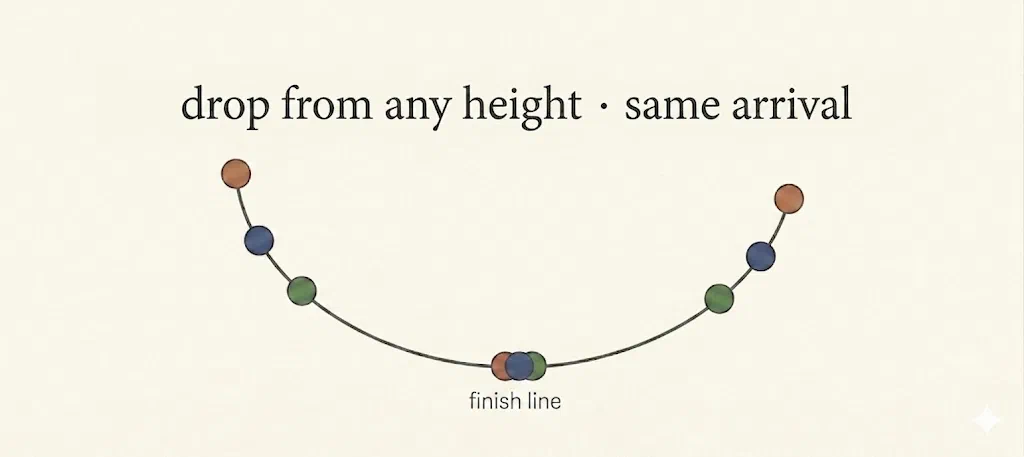
Different starting heights, same arrival time.
Huygens, in a stroke of genius, flanked his pendulum’s cord with two curved cheeks, themselves cycloids, so that the swinging cord peeled along them and bent the bob onto a cycloidal path.
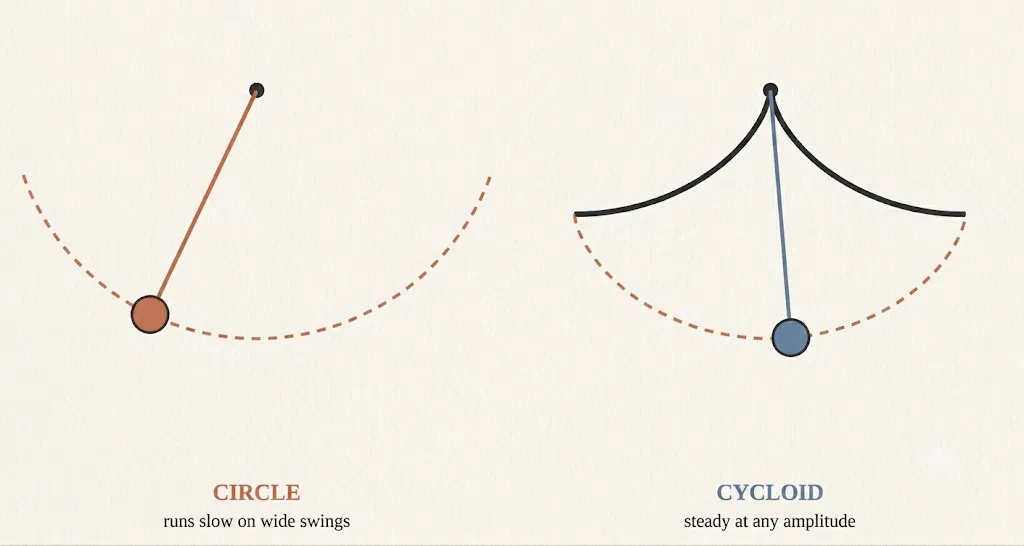
This cycloid curve is a bit alien-looking and completely correct.2
His substitution solved the problem, and history did not choose it. Landes gave us the above story and throughout Revolution in Time excels at describing exquisite, true solutions that did not win out. Often, they were beaten out by cheaper, good-enough solutions that were, critically, easier to reproduce.3
The second resolution is domain restriction: don’t replace the flawed solution — confine it to the region where it behaves. The anchor escapement, arriving around 1670, restricted the pendulum to a swing of just a few degrees — instead of the verge’s wild twenty or more — where the circle and the cycloid happen to coincide.4 Clockmakers immediately saw the advantage of this good-enough solution. Huygens’s elegant cheeks were abandoned — at so small a swing the circular error was already negligible, while the cheeks added problems of their own, the suspension cord wearing where it pressed against them, so they did more harm than good. The clockmakers kept the circle.
I find the second resolution more instructive precisely because it is less beautiful. Substitution is admirable, but perfection is fragile. The working solution was to re-engineer the conditions, so the crisis was mitigated. The difficulty had not vanished. It had moved.
Let’s fast forward to today for a moment. We are told (and I believe) that AI is a paradigm-shattering revolution — a completely new kind of clock. But as I argued in De-Dramatizing the Digital, technologies rarely start over. We build flawed systems, drag their imperfections forward, and grow new subsystems to contain them. The clockmakers did not choose the cycloid; they built the anchor escapement, narrowing the pendulum’s swing to a very small angle. We are doing the same thing now with AI.
The harnesses going up around raw models — retrieval scaffolds, agent loops, guardrails — are anchor escapements, not corrections to the underlying intelligence. They don’t repair the underlying motion, but convert a headlong torrent into something countable, stoppable, and true. Retrieval gives the model an external reference instead of asking it to invent from memory. Guardrails narrow the range of permissible motion. Agent loops break a single fluent torrent into smaller, inspectable steps. Together they make the flawed thing useful without making it flawless. AI’s confident wrongness — the hallucinations, the made-up citations — is the new circular error. The flaw is load-bearing now, and I for one love the practical art of designing around imperfection.
The Conservation of Difficulty
To bound an error is to relocate its difficulty, not eliminate it. This is the second part of my argument: the conservation of difficulty. Once the pendulum’s geometry was tamed, the problem did not disappear. The anchor escapement bounded circular error by leaving the circle in place and narrowing the conditions under which it operated. And so the anchor escapement became the locus of difficulty, and from then on a load-bearing part no one could remove. A technology improves by accreting compensations around its permanent flaws, not by becoming perfect. It becomes more complex and more capable at the same time. The pendulum was no longer the bottleneck; the escapement was. And when one stage of a chain is solved, standardized, or commoditized, both difficulty and value migrate to the adjacent stage that has become newly decisive. Difficulty is conserved. It only ever moves.5
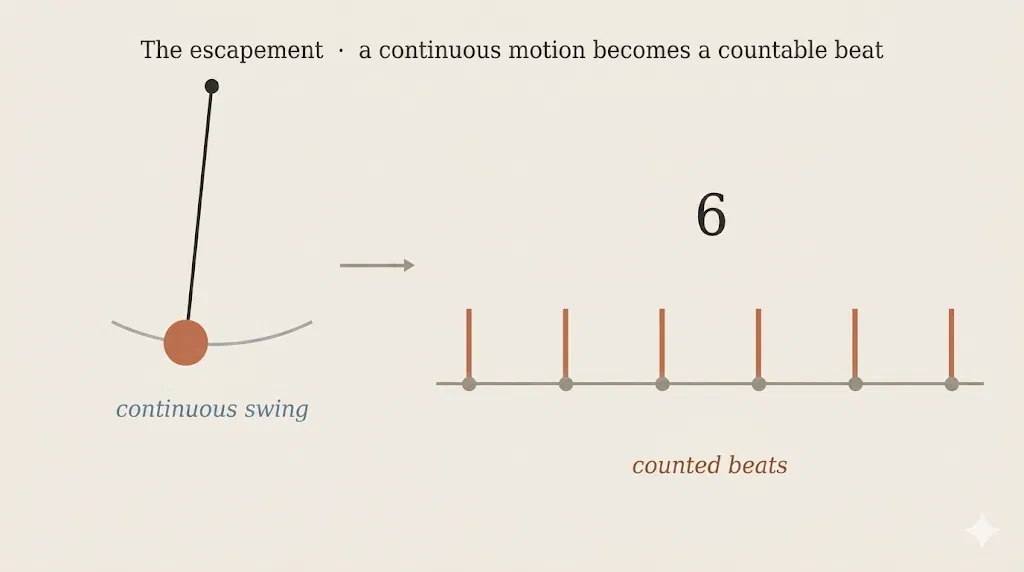
The swing on the left; the counted beats on the right.
The Longitude Problem and the Portable Clock
Eventually, it becomes necessary to go back to the drawing board when the solution can no longer solve its original problem. On land, the terrestrial pendulum clock had become the most accurate timekeeper on Earth. But the rocking of the ocean made the pendulum fundamentally unsuitable. A ship deck rolls and pitches; the bob’s pull is no longer reliably straight down. The pendulum must be abandoned.
So what? Because the clock seemed poised to solve the great problem of the age: longitude. Latitude is comparatively easy: the height of the sun or stars tells you how far north or south you are. Longitude is harder because it is not written in the sky in the same direct way. It is a difference in time. The Earth turns fifteen degrees every hour, so if noon arrives on your ship three hours later than it does at Greenwich, you are forty-five degrees west of Greenwich. To know where you are east or west, then, you need two times at once: the local time where you are, read from the sun, and a reliable reference time carried from a known place. The reference clock already existed on land. What was missing was one that could keep that reference accurately across months at sea.
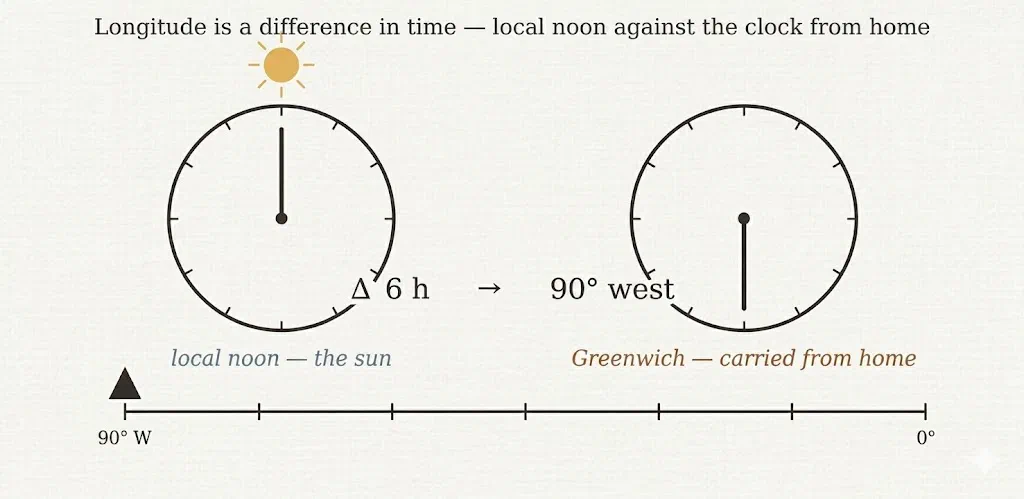
The gap between two clocks: local noon and the time carried from Greenwich.
Again, the difficulty migrated — out of the pendulum, which could not go to sea, and into a portable oscillator. John Harrison’s marine chronometers abandoned the pendulum entirely, replacing it with a balance wheel and balance spring, a mechanism far less vulnerable to a ship’s motion because it oscillated against itself rather than against gravity.
The marine version, of course, had its own “circular errors.” The balance wheel and balance spring could travel because they carried their restoring force inside the mechanism rather than depending on gravity’s fixed direction. That made them indispensable at sea, but they were not pure: temperature changed the spring, friction drained motion, the mainspring delivered uneven force, and each impulse risked disturbing the very oscillation it sustained. But these were errors that could be bounded, compensated, and built around.
And so the genealogy split in two. The pendulum-and-anchor line stayed on land and became the observatory regulator, the source of canonical time. The balance-spring line went portable — and it did not stop at the sea. It went into the pocket, and it kept shrinking: the marine chronometer, the precise watch, the wristwatch, the quartz movement, the phone in your hand. Landes draws the whole arc:
It took five hundred years to go from the turret clocks of the Middle Ages to marine chronometers and precision watches, from public time to private time, from dials with one hand to dials with three.
The move from public time to private time changed more than navigation.6 Landes again:
Where people had once depended on the cry of the night watch, the bell of the church, or the turret clock in the town square, now they had the time at home or on their person and could order their life and work in a manner once reserved to regulated communities. In this way, privatization of time was a major stimulus to the individualism that was an ever more salient aspect of Western civilization.
Now we own our own time, and this comes with a new bespoke circular error. You need to manage it. When the time becomes yours, so does the responsibility for it. The difficulty does not vanish; it migrates to you. Now nothing tells us when to start or stop, and the freedom arrives with a low hum of guilt — the sense that you are spending your hours wrong, that you ought to be doing more. The burden falls unevenly; some feel it more than others, and a thick obligation that puts you somewhere at a set time is often a relief, not a cage. But the shape is the same as every other circle in this essay: solve one problem, and the difficulty moves next door. Here it moves into you.7
None of this is the whole story of the clock — Lewis Mumford called the clock, not the steam engine, the key machine of the modern industrial age,8 and for the full story read Revolution in Time (it’s great). But this is one real thread of it, one that keeps reappearing: a solution that is almost right, made load-bearing, passing its difficulty along. It runs the gamut right into the phone you are probably reading this on.
A Long Coda on the Divergence Machine
The clock can make one corner of our own era more legible. If you came for the clocks, you can stop here; from here out it is a Contraptions book-club piece, for the world-machine heads.
The World Machines project reads history as a sequence of long-lived civilizational systems: overlapping machines that organize institutions, technologies, habits, and assumptions across centuries. At any moment, one machine is usually dominant, one is declining, and one is still being assembled. You can see the overlap in any office that runs this year’s software on top of paper-form logic, governed by fifty-year-old processes. We are living in just such an overlap: the Modernity Machine in dusk, the Divergence Machine entering day, and the first outlines of the Liveness Machine. Modernity pulled toward a single future; Divergence pushes outward into many. I unpack the pair in Babel Was a Clue.
It is tempting to assign each machine its own clock — the observatory pendulum to Modernity, the marine chronometer to Divergence. That is too neat. Machines do not replace one another like swapping gears; they interpenetrate. The same clock that helped centralize modern time also made private time portable.
That is the clock’s seed of divergence. When everyone carries the same time, the center need not hold. The Modernity Machine ran on central time: legible, standardized coordination at scale. The Divergence Machine inherits that standard, then loosens its social meaning: a billion private clocks, all keeping the same time, but using it to assemble different lives, different schedules, different markets, different worlds. Coordination without a center.
The Divergence Machine is not the perfect curve we were waiting for. It is the next inherited circle: almost right, already useful, and already accumulating new errors and compensations. It inherits the Modernity Machine’s surviving parts — its institutions, standards, theories, protocols, and above all its archive. What Sachin calls archival time9 matters here because AI does not learn from the world directly. It learns from the world as preserved: recorded, categorized, and made searchable. That gives AI its power and its error at once. The archive makes cognition scalable, but it also passes forward the archive’s absences, categories, and distortions. So the difficulty migrates from recording the world to judging the record.
The pattern repeats well past the archive. The nation-state remains the default unit of legitimacy, so difficulty migrates into passports, jurisdictions, sanctions, and compliance. Standardized measures make comparison possible but flatten what they measure, so difficulty migrates into translation layers, alternative metrics, audits, and exceptions. Each inherited circle needs its own escapement.
This can still work, but only as a discipline. We must be explicit about what errors we are going to accept and mitigate. Some parts of Modernity will decay on their own; others — standards, institutions, states, archives — are load-bearing and will have to be maintained long after their original context has expired. The transition becomes a Ship-of-Theseus problem: some planks are swapped cleanly while others are circular errors that need to be contained and mitigated. The difficulty migrates into the discernment to know what needs preserving and what has to be let go. This is often beyond any one person or nation’s control.
Here the clock history gives a design rule. A delicate oscillator is made useful by disturbing it as little as possible; the correction belongs beside the core, not inside it. Harrison and Le Roy got accuracy by leaving the balance nearly free and adding control alongside it. Inherited errors should be handled the same way: identify the flaw, bound it with a legible adjacent layer, and do not dull the thing that made the core worth keeping.
Drop that discipline, and the same approach becomes the failure mode. Back to AI. The harder we make a model behave, the more easily we bury what made it useful under the machinery meant to control it: a guardrail here, a retrieval step there, a human review, a second model checking the first. Each patch is reasonable, and each stays legible when its job is clear and inspectable — the retrieval layer points to the source it pulled from, the guardrail marks the boundary it enforces, the human review flags the call only a person should make. Lose that clarity, and the patches become a tangle no one designed, no one fully understands, and no one can remove without making the whole thing wobble. Then difficulty no longer migrates into a useful adjacent layer; it migrates into opacity and endless upkeep. The fork is simple: whether the compensations stay legible.
The World Machines project asks, among its open questions, what the characteristic pathologies of each phase are — how a machine deteriorates, not just how it lives. I’m putting forward a theory: a World Machine accumulates technical debt. In Dawn, almost-right inventions are useful but not yet obligatory; the difficulty still lives in invention, choice, and experiment. In Day, the winners harden into standards, institutions, protocols, and habits; difficulty migrates to the adjacent systems needed to maintain them. In Dusk, those compensations can no longer be sustained, collapsing into bottlenecks and debt service. A machine advances by borrowing against the future: keeping the almost-right core because it works, then paying interest through the compensations required to keep it working. It can carry that debt so long as it is still solving the problems it exists for.
World Machines can sound, rightly, like weather systems with names: Modernity, Divergence, Liveness. The clock metaphor brings them down to earth. A machine is not only an age with a mood; it is a pile of tolerances, kludges, and almost-true assumptions that proved too serviceable to throw away. No machine is without its errors; we learn over centuries which ones are load-bearing, which ones can be bounded, and which ones can be made to work. The chronometer’s chosen error was seaworthy enough to cross an ocean, provided someone wound and watched it the whole way.
While some systems may correct themselves, the real labor of maintenance belongs to people. This does not mean we are trapped within the machinery of history. There is still as much freedom as there ever was. There are many new things to be made, and both maintenance and solving difficult problems demand their own kind of creativity. It is tempting to picture great historical systems as cold powers that determine our lives, but we evolve with the things we make. The clock altered how we live and work, yet we did not simply bow to its mechanics. When early pendulums drifted too far, human judgment answered with the anchor escapement. The deep infrastructures of the world shape us, and we, in turn, shape them right back.
The anecdote is almost certainly embellished — the famous lamp was hung in the cathedral after 1583, so it cannot be the one he watched. ↩
The same cycloid is also the brachistochrone, the curve of fastest descent between two points. Galileo had taken up the question in 1638 and guessed the answer was an arc of a circle — right that some curve beats the straight line, wrong about which curve. It was settled only in 1696, when Johann Bernoulli posed it as an open challenge to the sharpest mathematicians in the world, baited (with Leibniz's help) to catch Newton in the calculus war. Newton, handed it after a long day at the Mint, refused to sleep until it fell at four in the morning, then answered anonymously; Bernoulli knew him at once — one knows the lion by its claw. The fitting irony: the curve that commanded the age's greatest minds was the one working clockmakers abandoned as too much trouble. ↩
The clearest case is in this very story. Harrison's prize-winning chronometers were marvels, but too intricate to copy; the marine chronometer that actually spread was the simpler, reproducible kind that Pierre Le Roy pointed toward and Thomas Earnshaw and John Arnold made cheap. The propagable solution beats the perfect one. ↩
Circular error grows with the square of the swing, not in step with it: Landes's rule of thumb is K ≈ 1.65 α², with α the semiarc — half the full swing — in degrees. So doubling the swing quadruples the error, and pulling a pendulum from a wide verge arc down to the anchor's few degrees collapses it more than thirtyfold. That quadratic is the real reason domain restriction works: confining the swing isn't a grudging compromise but geometry playing out. ↩
A reminder that when you build on something imperfect, the difficulty doesn't vanish, it moves; go look for where it went. Terence Tao has a stricter "law of conservation of difficulty" in mathematics — any genuinely non-trivial result takes hard work somewhere — though he notes there is no rigorous version of it yet. ↩
VGR walks this same road — cannon to chronometer to factory, public time to private — in two May 2026 pieces, "From Cannons to Chronometers to Factories" and "Time, Enlightenment and Romanticism Between Modernity and Divergence." ↩
Personal time and its discontents deserve their own essay, which I will take up later. ↩
Lewis Mumford, Technics and Civilization (1934): "The clock, not the steam-engine, is the key-machine of the modern industrial age." ↩
Sachin's term, from his archival-vs-carnival-time piece "Archival Time" at Summer Lightning. Archival time is the private, written, asynchronous record; carnival time is the public, embodied, synchronous kind. AI is built almost entirely from the first. ↩