Cosmological Adventure
Wayfinding in the Divergence Machine
During the back half of my honeymoon, on the sleepy South Pacific atoll of Rangiroa, my wife and I sat under a thatched-roof pavilion watching an ‘Ori Tahiti performance. The air tasted of salt and tiare flowers. The next day we would cross the world’s second largest lagoon to spend three nights in a cabana without electricity, playing at being castaways — the greatest three days I have spent anywhere in the world.
Amid the native Polynesian dancers — moving flawlessly in coconut shell tops, grass skirts, and feathered headpieces — I noticed a few non-native, likely French teenagers performing as part of the troupe. The likely reason was a cultural exchange, but this is not where my mind went. I immediately started spinning an elaborate, cinematic narrative: these kids are on the run. What clever disguises. I pictured a Some Like It Hot situation — these kids hiding out in a Polynesian dance review to escape the cops, their parents, or the mob, possibly all three. I sat there sipping a drink, sure of it, thinking: what a brilliant idea, I wish I was on the run.
Then I turned and looked at my wife. A quiet absurdity washed over me. Why do I want everything I do to be mythic in its awesomeness? Why was I mentally manufacturing a high-stakes adventure, casting myself as a fleeing outlaw, while I was supposed to be fully present and enjoying my honeymoon? I flashed her a smile.
It’s not my fault. I was mis-equipped. We were given only one model of adventure — the kind that demands leaving. So even as we stay in our own lives, we find ourselves mentally slipping away into small fantasies of escape. It runs in the background like a piece of obsolete software. It can make the people next to us feel like obstacles.
The wrong story, and the right shape of the drive
The story I had inherited came in two versions, and both are exhausted.
The first version was the Hollywood monomyth. Joseph Campbell flowed into George Lucas flowed into the MCU, and the result was a reflexive blueprint: a young hero receives a call, leaves home, slays the dragon, returns with a boon. We absorbed the form so thoroughly that we now apply it to everything, including our own lives. This version is exhausted because Hollywood has been strip-mining it for fifty years and also, more quietly, it was essentially a story for adolescents — a coming-of-age narrative useful for crossing from youth into adulthood, but with little to offer thereafter. By the time you are in the middle of your life, you are well past that door, and yet the call-to-adventure keeps misfiring, telling you to leave a home you already left.1
The second version was the colonial expedition — the adventure form of the Modernity Machine (MM)2, the four-century civilizational project of converting heterogeneity into legible, interoperable order. The expedition’s job was to extend that legibility to the last unmapped places, planting flags, expanding maps, and returning with riches and honor. The romance of John Huston’s The Man Who Would Be King3 is this form at its most cinematically pure. This version is exhausted because there is no terra incognita left to plant a flag in, and — more importantly — we have seen the outcomes and cannot believe it is still heroic. Future adventure needs to kick the dirt of colonialism off its shoes and move forward unencumbered.
You can see what happens when these two stories run uncorrected in adult lives. The midlife crisis is a calendar event for someone who has been told the only legitimate adventure is the one that requires leaving. The bucket-list trip, the new career, the second house, the dramatic resignation letter — each is the call-to-adventure firing one more time, because the call cannot be turned off, only redirected.
We will never outgrow the desire for adventure — nor should we — and it points to a deeper drive. It’s only our current story of adventure that is leading us astray.
This month in the Contraptions book club, we have been reading Andrea Wulf’s Magnificent Rebels and The Invention of Nature — twin biographies of the Jena Romantics and Alexander von Humboldt. Reading them in parallel, you keep running into Friedrich Schiller, who in 1795, in a series of letters, diagnosed what remains the central crisis of the modern mind.4 Enlightenment rationality, Schiller argued, had torn human freedom and the natural world apart. We were left divided between cold logic and chaotic sensuality. To reconcile them, he proposed, we rely on the Spieltrieb — the play drive, the aesthetic drive. Not play in the frivolous sense; play as the human capacity to shape form from matter without coercing it. To unite our inner freedom with the givenness of the natural world.
Romance, in all its dictionary senses, is this drive operating on different terrains. Adventure-romance is the aesthetic drive turned outward, uniting freedom with nature on the expedition, the mountain, the open ocean. Relationship-romance is the same drive turned inward, uniting freedom with nature in the psyche and in the unmappable space between two people. They are the same longing, wearing different clothes for different seasons of a life.
This is why the man who, on his honeymoon, fantasizes about being on the run is not actually torn between adventure and intimacy. He is one person practicing one drive. We need a different story about what adventure is. To find it, we have to go to two places: the Andes in 1802, and the open Pacific.
Two figures who got it right
In 1799, Alexander von Humboldt arrived in South America. For five years he traveled — up the Orinoco, across the Andes, up the slopes of Chimborazo, then believed to be the highest mountain in the world. But Humboldt was not there to plant a flag or extract gold. He was there to pay rigorous attention. He hauled barometers and electrometers up sheer rock faces. He climbed Chimborazo with blood oozing from his gums, refusing to let altitude sickness dull his observations.
What he came back with was not territory. It was a diagram. The Naturgemälde — a single illustration in which every plant zone, every elevation, every climatic band of the Andes is rendered together, with the relationships between them visible at a glance. It was an infographic two centuries ahead of its time. But the deeper claim was metaphysical: nature was not a clockwork of isolated parts. It was a single, interdependent web. A lichen at fifteen thousand feet in the Andes shared a biological kinship with a lichen in the Swiss Alps. This relational, holistic view is not just a diagram, but a cognitive architecture for successfully navigating the Divergence Machine (DM) — the world machine that is now coming online as the MM winds down — where pervasive diversity is a feature, not a problem.
As Charles Taylor puts it in Cosmic Connections, this was the central ideal of Romanticism: the perfect reconciliation of freedom and nature. Humboldt was not a Romantic poet who happened to do science. He was the proof that the Romantic ideal was a rigorous, observable practice. Schiller’s Spieltrieb, at full pitch, on a mountain. Andrea Wulf describes how Humboldt dedicated his first essay on plant geography to the great poet Goethe, his mentor:5
The Essay’s frontispiece depicted Apollo, the god of poetry, lifting the veil from the goddess of nature — making it perfectly clear that poetry was necessary to comprehend the mysteries of the natural world.
Humboldt’s intuition needs a bigger frame, though. He was doing the work of the MM — the four-century project of converting the world into legible, canonical knowledge — but he was making it in a way that pointed past the machine he was working for. The web of life he drew was not legible in the modernity sense. It was relational, plural, irreducible to a list. He was doing the work of the Divergence Machine before there was a name for it. The DM favors pervasive diversity, plural modes of being, and coexistence without closure. Adventure inside the DM cannot be the old expedition redux. It has to be something the MM would not have produced.
What does that look like in practice? Humboldt gave us the vision of the connected web, but to make it real for ourselves we need to look at Polynesian wayfinding.
One year after our honeymoon, my wife and I returned to the Pacific for our anniversary, this time to Hawaii. Near the summit of Mauna Kea, in air so clear it felt thin, our guide pointed at the sky with a green laser. He was not, he told us, looking at the stars as constellations but as paths. A star path is the track a particular star follows across the sky, and Polynesian navigators learned those tracks as reliable directional guides. Instead of thinking first in terms of fixed Western-style constellations, they often thought in terms of where a star rises, how it arcs overhead, and where it sets. The Polynesian navigators had seen the sky differently, not as a picture but as a road. He pointed at a moving pinprick of light, so faint I was surprised I could see it. That’s a satellite. Up here you can see them right overhead.
I had been thinking about stars wrong my whole life.
The Polynesians had been navigating that highway since well before the Common Era. The European consensus, convinced that real exploration required astrolabes and sextants, argued that they must have settled the vast Pacific by accidental drift. Navigating without instruments was indistinguishable, to the modernity machine, from aimless wandering. It could not imagine a mental architecture capable of holding the entire night sky.
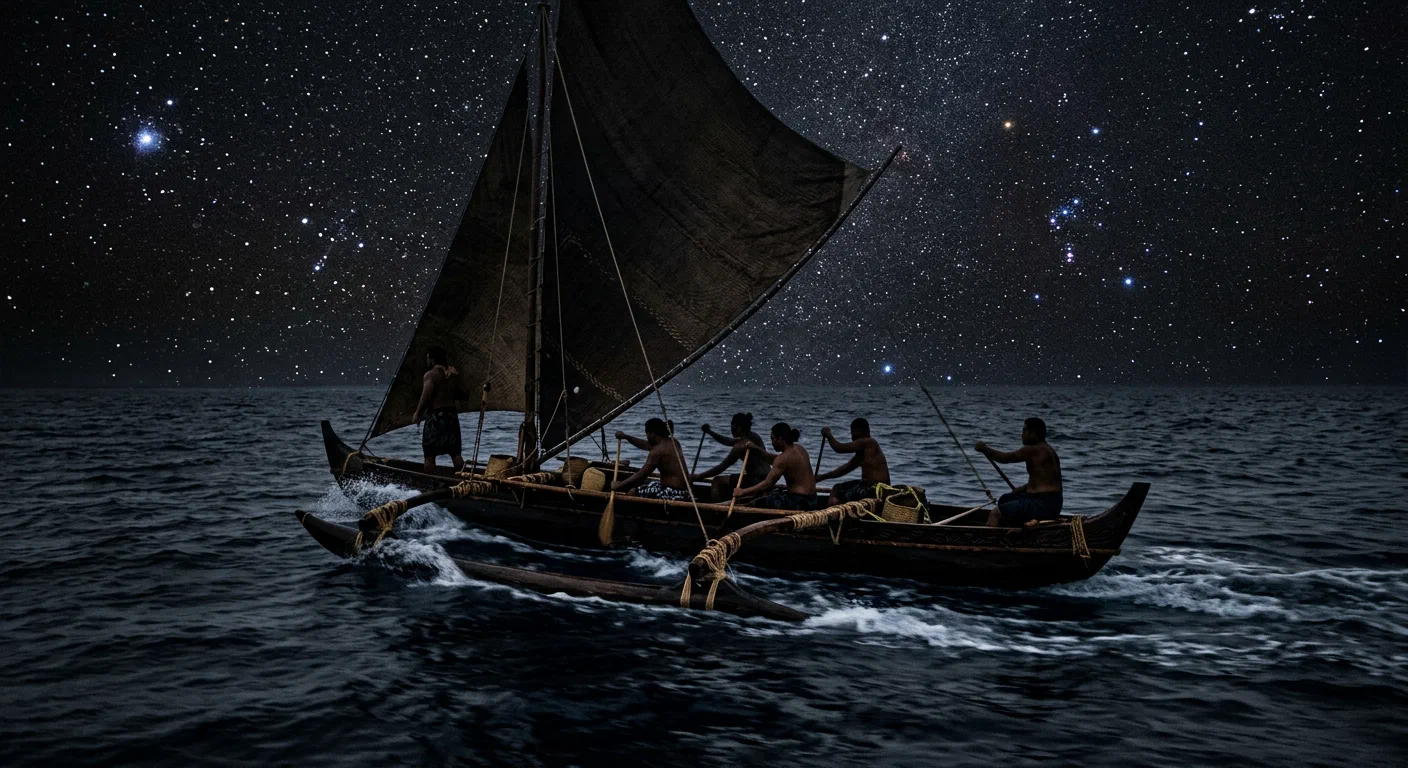
In 1976, the Polynesian Voyaging Society set out to refute the drift theory by doing the thing the theory said was impossible. They built the Hōkūleʻa, a traditional double-hulled voyaging canoe, and sailed it from Hawaiʻi to Tahiti without a single modern instrument. Guided by Mau Piailug — a master navigator from Micronesia, brought in because Hawaiʻi had lost its own line of navigators across the intervening centuries — they navigated by reading the rising and setting of stars, the temperature of the water, the slap of the swells on the hull, the flight paths of seabirds, the faint green tint on the underside of a cloud reflecting a lagoon hundreds of miles away.
Modernity was also woven into their success. Nainoa Thompson, the apprentice who would become the next master, used a planetarium to memorize the stars because the Honolulu sky was too bright with light pollution. They were not just doing this as a one-off exhibition, but to create a new line of navigators and resurrect their tradition and heritage. They made it reproducible.
The wayfinder carries a star compass, a memorized horizon whose thirty-two named houses organize the sky around the canoe. Keeping the canoe at the experiential center, the navigator maintains orientation by moving from star to star and by attending to swells, winds, birds, and other environmental signs.
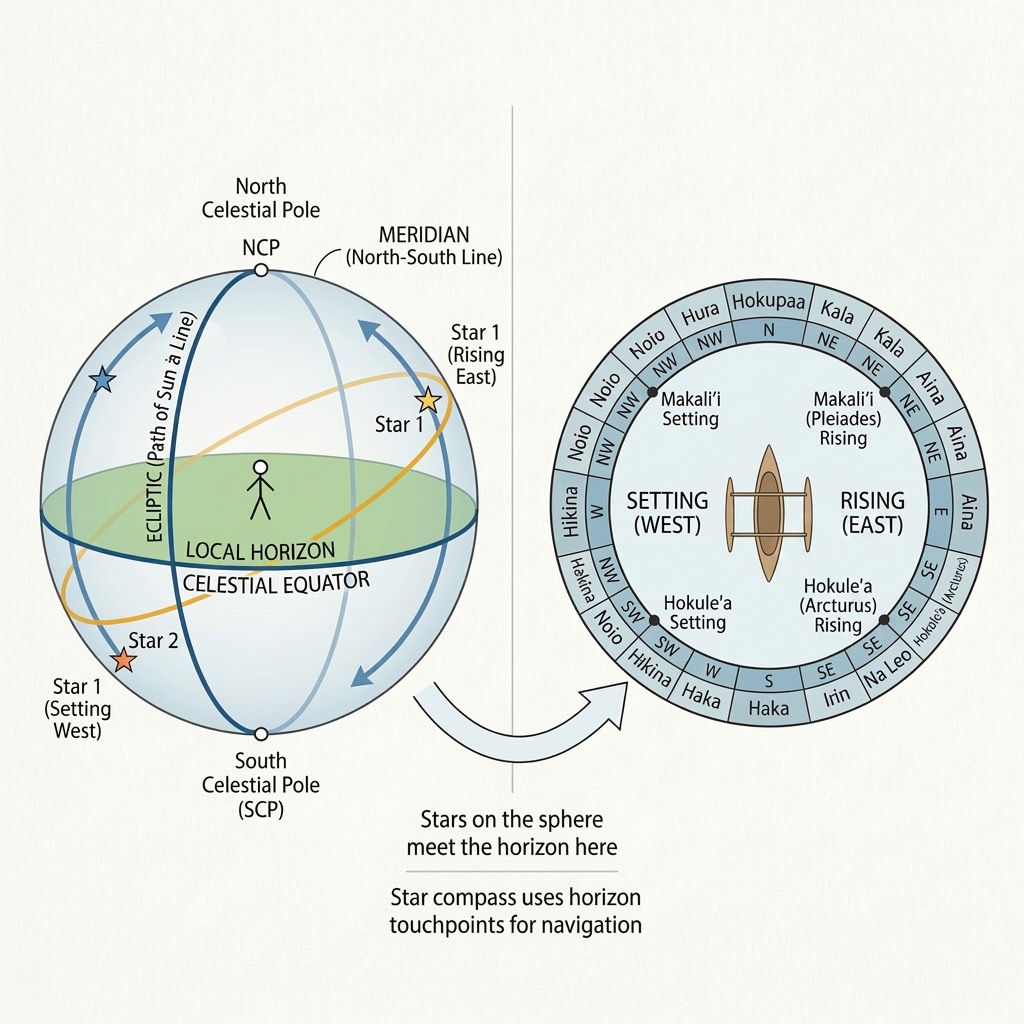
The wayfinder does not separate the stars from the currents from the canoe from themselves. They are a single field of orientation. And when the navigator wants to know how high a star is — how far north or south they are — they do not reach for an instrument. They extend their own arm.
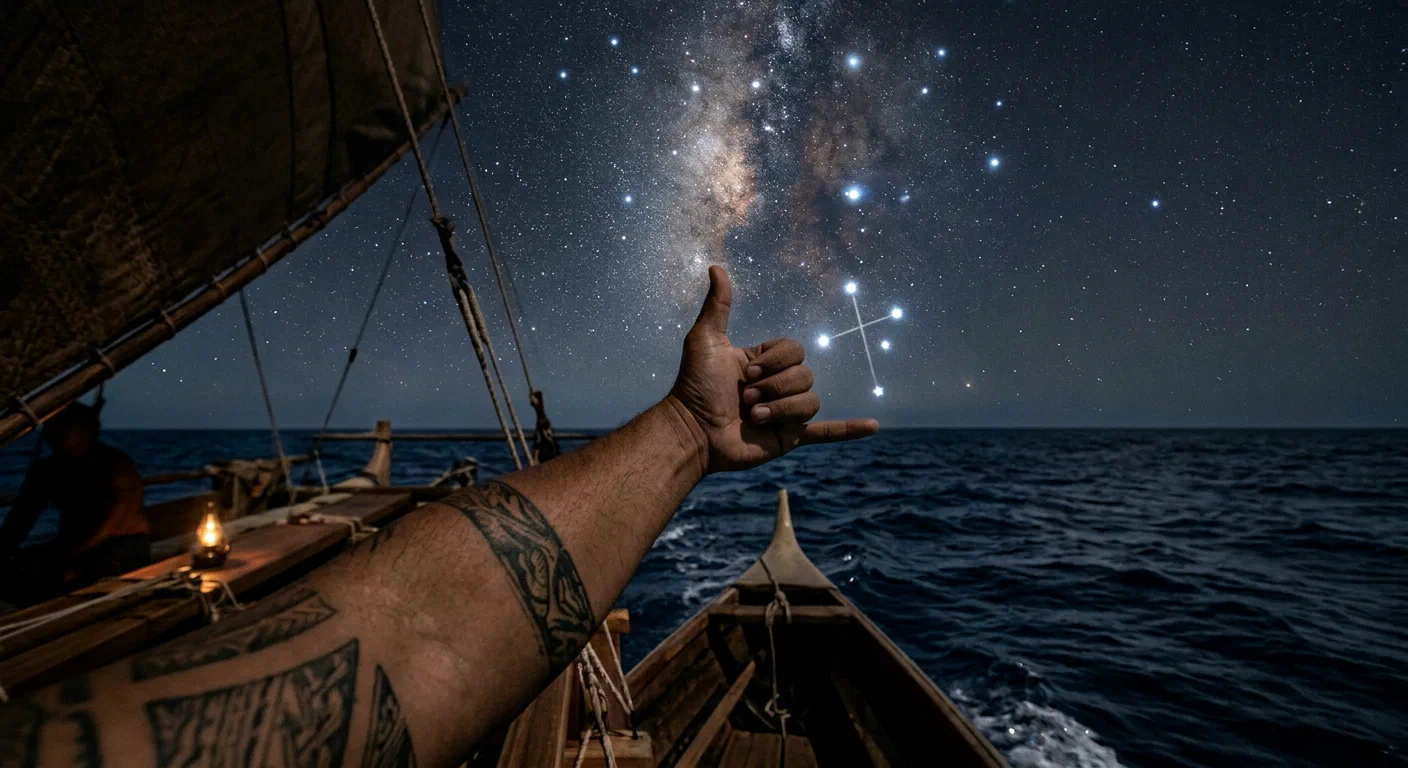
The outstretched hand, in several practiced shapes, gives the angle from horizon to star; from that angle, read within a memorized system of stellar bearings, the navigator can estimate position. Wayfinding makes the body itself the medium of measure. In this gesture man is once again the measure of all things6
Looking up
The reason adventure has become cosmological in the Divergence Machine is that the only frontier we have left is the one we forgot how to inhabit. The Pacific has been crossed, the Andes climbed, the maps filled in. What we have not done in a long time is look up.
I tried, once, at a dark sky park. The constellations I had not been able to see in any city I had ever lived in were suddenly all there, and behind them the Milky Way was not a smattering of distant pinpricks but a dense, physical structure, almost threatening in its scale. I was terrified. I felt small, alone, and disconnected from everything, even though my wife was standing right next to me. She still makes fun of me.
What I was touching is what Hans Blumenberg called the absolutism of reality7 — the indifferent presence of a universe not configured for human meaning. Myth-work, in Blumenberg’s reading, is the long human practice of making that absolutism livable. The point is not to deny what is terrible about it but to find a way to be in its presence without breaking. The terror at the dark-sky park and the awe of the Mauna Kea guide pointing his laser at a satellite were the same encounter, taken in different registers. Modernity gave us a way to manage the absolutism: it taught us to look down, and the cosmos turned into a backdrop. We lost it as something we could actively inhabit.
Anaxagoras was once asked why it is better to be born than not to exist. He answered, simply, that it was to behold the heavens and the whole order of the universe.8 The practice of looking up does not require us to reverse modernity. It requires that we hold two thoughts at once: that the cosmos is foreign and indifferent, and that it is also our only home, having birthed us through evolution as the part of itself that beholds the rest. Wayfinding bridges this divide: it is cosmological and human-scaled — the body holding both thoughts at once.
The practice, and what we bring back
If we are to resurrect the hero’s journey for the Divergence Machine — to make it one myth among many — we need to ask what boon it can still bring back. The voyage of the Hōkūleʻa was not without tragedy. Eddie Aikau, a Hawaiian lifeguard and the Polynesian Voyaging Society’s first crew lost at sea, paddled out on a surfboard in a storm to try to save his crewmates and was never seen again. The Society considered ending the voyages. They did not, because the practice would die with him. Surviving the tragedy deepened the meaning of what they ultimately accomplished. They brought back a boon for their culture, for the wider Pacific, and did something literally mythic in its awesomeness.
What the Polynesian wayfinders enacted is Schiller’s Spieltrieb at full velocity — freedom and nature reconciled by the body’s attention.
Here in the foothills of a new era, we need new ways of seeing9. The capacity to see wholes where we had only seen pieces, to connect heaven and earth — what the Hawaiian wayfinders call Ka Piko o Wākea10 — the navel of the Sky Father, where all the skies converge. This is the boon for the whole world.
River Kenna’s diagnosis: the call-to-adventure has become a “jammed door” we keep throwing our bodies against, mistaking the mismatch between the form and our actual lives for our own failure to launch. See “The Hero’s Journey Is a Jammed Door“ at Inner Wilds. ↩
I’m borrowing the framework from Venkatesh Rao’s World Machines project at Contraptions. A “world machine” is a civilization-scale contraption that takes roughly four hundred years to build, four hundred to dominate, and four hundred to wind down. The Modernity Machine ran 1200–1600 in construction and 1600–2000 dominant, optimized for legibility and promoting progress. The Divergence Machine has been built on its margins and is now switching on; its move is to make the Modernity Machine irrelevant in favor of pervasive diversity and coexistence without closure. The 2026 Contraptions Book Club is focused on this concept this year. ↩
To be clear I love this movie.
↩For a longer treatment of Schiller’s Letters Upon the Aesthetic Education of Man, see The Partially Examined Life — the philosophy podcast has covered the Letters in detail. ↩
Andrea Wulf, The Invention of Nature: Alexander von Humboldt’s New World (Knopf, 2015). The “Essay” Wulf is referring to is Humboldt’s Essay on the Geography of Plants (1807), which he dedicated to Goethe. ↩
The same discipline travels off the water. Boyd Varty’s The Lion Tracker’s Guide to Life (2019) is a short book about tracking as a way of life — adaptive navigation under partial knowledge, with the body as the instrument. You read the slightest signs (a bent grass blade, a faint print), accept that you don’t know where you’ll end up, and proceed by attending to what’s actually present. Varty’s mentor Renias Mhlongo, a master Shangaan tracker, is to him what Mau Piailug was to Nainoa Thompson: a master in a tradition transmitted from outside the apprentice’s own broken line. The world is readable; the body is the instrument; the practice is taught. ↩
Hans Blumenberg, Work on Myth (1979; English translation MIT, 1985). Blumenberg’s Absolutismus der Wirklichkeit is the bare, pre-symbolic indifference of the world to human meaning; myth-work is the long practice of making that indifference inhabitable. Blumenberg will be a mainstay of my work on Substack this year. ↩
The exchange is reported in Diogenes Laertius, Lives of the Eminent Philosophers, II.10. To behold the heavens and the whole order of the universe — the answer Anaxagoras gives Pericles when asked why a person should bother being born. ↩
A current example: Paul Salopek’s Out of Eden Walk (2013–present), a slow-journalism project retracing the path of human migration on foot from the Rift Valley in Ethiopia to Tierra del Fuego, walking with local guides at every stage. Twelve years in and still going. He stops every hundred miles for what he calls a “milestone” — long-form interviews and observations from wherever he happens to be. Non-extractive, attention-based, scaled to human pace, transmitting knowledge across boundaries. The opposite of a flag-and-ledger expedition. Find a great overview here - https://pioneeringspirit.xyz/walking-the-world-machines ↩
Piko in Hawaiian means navel, the umbilical center, the connecting point. Wākea is the sky-father in Hawaiian cosmology. Piko o Wākea is the equator — the celestial seam where the wayfinder, crossing it, is “born” into a new sky as the southern stars rise into view and a different cosmos arises overhead. ↩