La Selva Oscura
Reoccupying Middle Age
The child that was human civilization had opened the door to her home and glanced outside. The endless night terrified her so much that she shuddered against the expansive and profound darkness, and shut the door firmly.
— Cixin Liu, Death’s End1
Nel mezzo del cammin di nostra vita / mi ritrovai per una selva oscura / ché la diritta via era smarrita.
Midway upon the journey of our life / I found myself in a dark forest, / for the straightforward path had been lost.
— Dante, Inferno I2
I awoke in a dark forest with the straight way lost at some point during COVID. I can’t point to exactly when, but it was an exact point. Like Zen master Dōgen says, “Summer does not follow spring. First there is spring, then there is summer.”3 Middle age does not follow youth. First there is youth then there is middle age. Just as firewood does not become ash, but rather firewood is at the stage of firewood and ash is at the stage of ash, life does not become death, and youth does not become middle age. I know it’s been said before that one day you just wake up like that but it’s actually true.
Soon thereafter, lost in my personal dark forest,4 I got a buzz-cut COVID-do and reading glasses, and eventually found my footing with my job and my way of life. Two surprising things happened. First, I saw the road to the end of my career — I could see all the way to retirement — and it would be exactly like the way it is now, forever. The question was no longer, how do I get there? but why does this feel less real than it did when I wanted it? Second, my inner map went blank. When the interior authority to choose a path dissolves, then no path that can be taken seems right. The straightforward path is lost, and what Jung called the encounter with the unconscious5 arrives unbidden.
The Crisis of Success
The exterior path remains clear, but the solid self that used to move forward begins to flicker. The external map — the next credential, the upgraded routine, the better-optimized life, the longer vacation — continues to function. It gives you stress but there’s also a new ease now that you have seen its sameness all the way to the end. You stop making memories at the same rate because the newness diminishes, and the lack of inner conviction begins to weigh on your mind. This is the crisis of success. Paradoxically, failure is much simpler to deal with. If you fail the world gives you errands: figure it out, make a new plan, and try again. Success can be stranger because it removes the justification to change. This dissonance between a still-functioning exterior and a now murkier interior is the dark forest.
Before I begin diagnosing eras and civilizations, a confession. I tend to ascribe to the world what I am feeling myself — I don’t think I am alone in this blemish. Currently, I am obsessed with the suspicion that my judgments are motivated almost entirely by my own stage of development. “Everything is boring,” oh yeah — “I’m boring.” “How bourgeois and stagnant the 21st century is.” Unfortunately, this means “I’m bourgeois and stagnant.” I didn’t worry about whether my boredom was a sign of civilizational collapse when I was twenty. I worry about it now. But just because I project doesn’t mean I’m wrong.
The Three Beasts
Dante knew what this looked like from inside. In the Inferno, he struggles out of the dark forest and eventually finds a sunlit hill. He begins to climb out by the direct route, and is blocked by the three beasts.6 He can’t go forward. The straight path of the first half of his life is now the wrong approach for what his soul is exploring; he must find a different way. It’s at this moment that his guide and mentor appears. In this essay the role of mentor is split: Dōgen takes the stages of life, Liu takes the cosmos, vanaprastha takes the discipline of stepping back.
I wrote in Cosmological Adventure that the Hero’s Journey has shifted from being aimed at midlife (Jesus, Buddha, Dante, and so on) to one aimed at the adolescent. Western culture has virtually no mythic vocabulary left for the path of middle age. That piece named the wrong-map problem. Now we look at what happens when the map disappears completely, and what happens to a civilization when it refuses to recognize where it is in its stage of development.
The German philosopher Hans Blumenberg has a useful word for what we are dealing with: reoccupation.7 When an old answer to a persistent question loses its force, the question itself does not go away — it waits, in an empty slot, for a new answer to occupy it. Western culture’s slot for the middle of life is empty. What we call midlife boredom is partly waiting for something to occupy this space, but answer comes there none.
The Cosmos as Selva Oscura
If the cost of refusing the midlife transition were merely private — a few exhausted adults wandering bourgeois suburbs — the stakes might not justify the essay. The midlife crisis can be civilizational as well, and the stakes are nowhere higher than in the Remembrance of Earth’s Past trilogy — the three novels we know in English as The Three-Body Problem, The Dark Forest, and Death’s End. Cixin Liu says it from inside the novel, in the voice of his protagonist Cheng Xin:
I am but an ordinary person. Unfortunately, I have not been able to walk the ordinary person’s path. My path is, in reality, the journey of a civilization.
The trilogy is usually read as a Cold-War parable or a cosmic-scale Hobbesian thought experiment in game theory. We will read it as Dante’s Inferno scaled to a species, and because it occurs in a dark forest, we will interpret it as a midlife crisis for human civilization. Liu is explicit about it. The frame he uses for civilizations is developmental. They have stages, like a life.
Like the first line in the Commedia (la diritta via era smarrita) the straight path for humanity has been lost. First contact with the alien Trisolarans wakes us, and we find ourselves in a cosmos-wide dark forest — a forest of armed hunters in which any civilization that reveals itself is destroyed by the others. The image at the top of this piece — the child opening the door, glancing into the night, slamming it shut — is Liu’s image for humanity’s response. It is the civilizational version of the refusal of the call. Humanity’s outward capacity remains intact — starships are buildable, the technology exists — but the inner confidence to leave collapses.
Leaning on Blumenberg again, this is the clearest recent expression of the absolutism of reality8 — the raw, indifferent totality of a universe that does not explain itself to us. Humanity told itself a story, a myth, of benign ‘first contact’ and ‘cosmic brotherhood.’ But Liu presents a universe that is not designed for us, where human history is cosmically unnoticeable. The moment of horror occurs when our species realizes that our cultural mediations — our myths — were never adequate to the raw, unmediated reality they were meant to tame.
Unable to face up to its predicament, humanity clings to the Earth, clings to the solar system, clings to the comfortable cosmology in which the universe owes us a future. Building enough starships to evacuate even a fraction of the species is technically possible but is considered immoral. “Escapism” is treated as a crime against the social fabric — if not all of us can leave, none of us should.
What humanity refuses, until it is almost too late, is a developmental journey that Liu lays out plainly:
And now we know that this is the journey that must be made by every civilization: awakening inside a cramped cradle, toddling out of it, taking flight, flying faster and farther, and, finally, merging with the fate of the universe as one.9
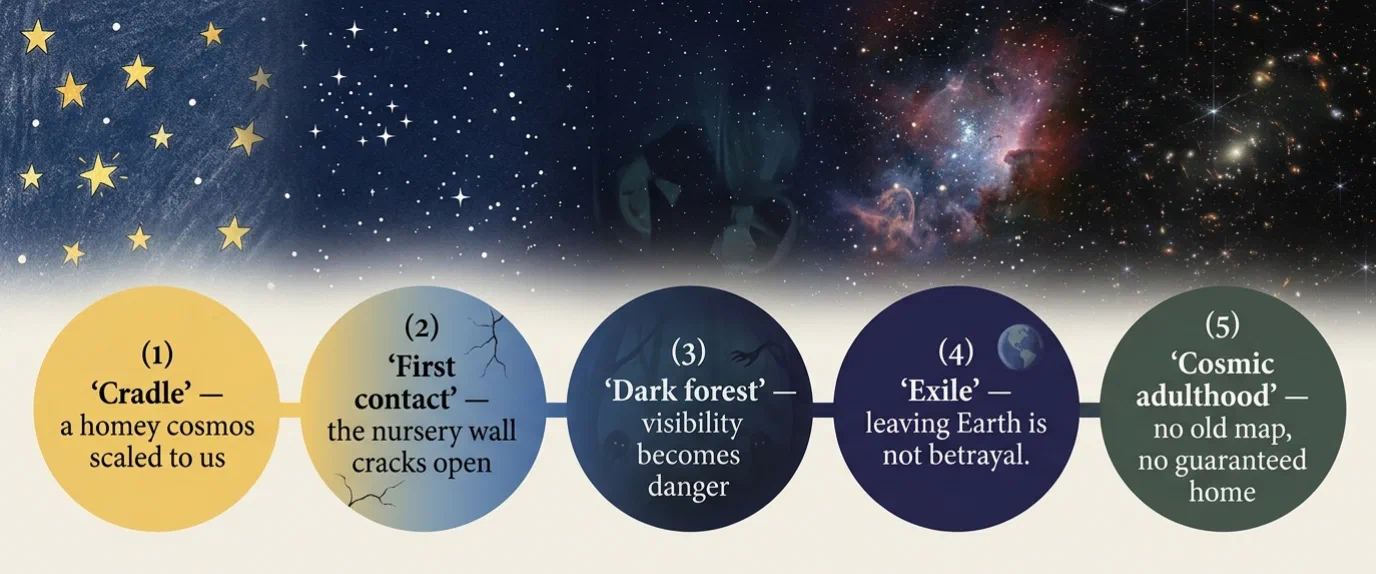
The cradle, the toddler, the flight — Liu names the developmental stages of a civilization the way we name the developmental stages of a person. It is the same expression Dōgen makes: each stage is its own complete state; firewood does not become ash, and the cradle is not flight. To remain in the cradle past the time of the cradle is to court disaster. The grown-up civilization, like the grown-up person, has to go through its dark adventure, and the boon it brings back is a cosmos-wide consciousness.
A New Thing in the Cosmos — Love
Humanity escapes by the skin of its teeth (I won’t give more spoilers — read the books) through the few ships that decided to leave the solar system decades earlier. They let go of the attachment to the Earth, and wayfound their way to a fruitful future for human civilization — knowing that the wider universe cannot be mapped in the old terms, that they will never return, and that the question now is not whether the map is wrong but how to live without a map at all.
Cheng Xin, Liu’s hero of the final book, has catastrophically failed humanity. Twice she was placed in a position of judgment and twice she chose love over violence. She refused to push the deterrent trigger when the Trisolarans attacked, even though it would have defended Earth. She blocked Wade’s lightspeed-ship program — the only viable escape — because his methods were ruthless. Both times the reflex — mercy, refusal of force, love as default — was catastrophically wrong. (I recognize her reflex. It is also mine.) Liu is unsparing about it:
Twice, she had been placed in a position of authority second only to God, and both times she had pushed the world into the abyss in the name of love.10
But Liu does not condemn her either. Near the end of the novel she is told what the essay needs the reader to hear:
Love isn’t wrong. A single individual cannot destroy a world. If that world was doomed, then it was the result of the efforts of everyone, including those living and those who had already died.11
There are also gentler voices in the trilogy. In the first book, a Trisolaran pacifist risked his life sending the “do not answer” warning to Earth.12 This same Trisolaran appears at the end of the second book, reflecting on whether love is uniquely human and imagining tiny pockets of love springing up throughout the galaxy if the conditions could change, but alas they most likely won’t. It would have been humanity’s genuine gift to the universe.
Cheng Xin’s small vessel escaping the solar system is a contemporary image of Dante’s pilgrim: a person for whom the path has vanished, and who must persevere. She survives for a time in a pocket universe outside our cosmos. When the cosmic cycle eventually requires that the matter of her shelter be returned, she gives it up — surrendering her final refuge so the larger order can be made whole.13 She faces the absolutism of reality without mediation. In the void she is a fragile creature, but her perseverance — the willingness to live in the dark, and to give back what was never really hers — is the ultimate act of self-assertion (Selbstbehauptung).14
The Remembrance of Earth’s Past trilogy is the Inferno of the Divergence Machine: the dark forest, the lost straight path, but applied to our whole world. (I await Liu Cixin’s Purgatorio.) Reading the trilogy as a science-fiction novel about aliens is reading it as a coming-of-age story. Reading it as a midlife myth — a trial without the consolation of paradise — is what we need in our moment. Or what I need — remember I ascribe to others what I see in myself. Why? Because the optimism and sentimentality of the hero’s journey is just not going to get us where we need to go.
Many Maps, No Path
It is worth at this moment to linger on a cross-cultural counterexample, not as a recommendation but as a contrast that exposes a blind spot. Hindu tradition divides the human life into four ashramas, four life-stages, each with its own discipline: brahmacharya (the student), grihastha (the householder), vanaprastha (the forest-dweller), and sannyasa (the renunciate).15 While some texts give special importance to the householder because that stage sustains society and makes the others possible, the stages are best understood as distinct disciplines rather than a simple ladder of promotion. The student is supported by the householder. The renunciate can withdraw because the householder maintains the world they are withdrawing from. The householder makes the hero possible.
The discipline that follows the householder is vanaprastha, the forest-dweller stage. The householder, having maintained the world for decades, begins a deliberate turn outward — a loosening of the daily grip, an investment in mentoring, a willingness to disengage from the immediate so the long-term can come into view. We have, again, no English word for this stage. We have midlife crises and we have retirement, and almost no language for the deliberate, mythic work of the transition between them. I see a need for the forest-dweller in Western society, the art of stepping back without disappearing.
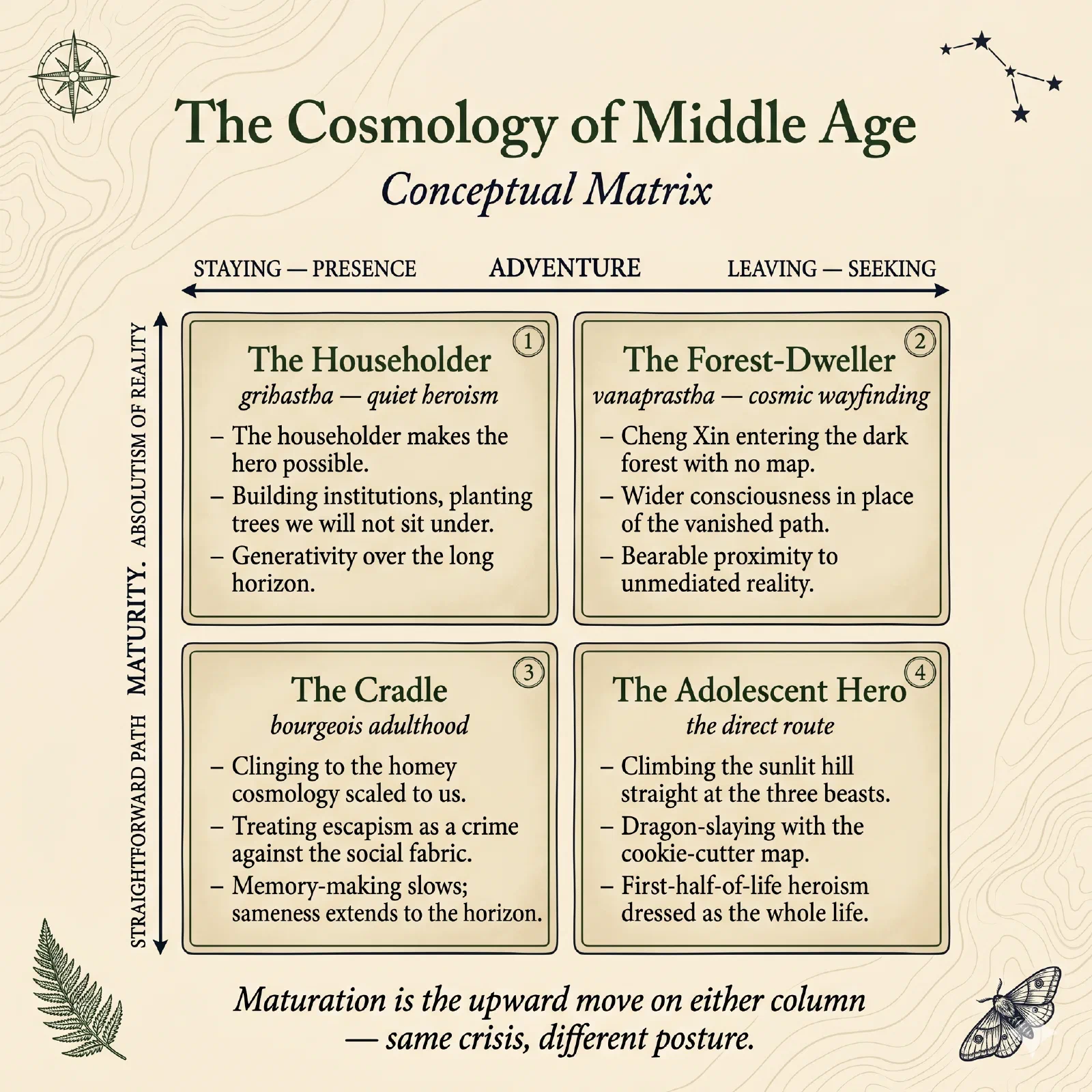
A mature life requires many myths, not just one. We need narratives for generativity — the quiet heroism of building institutions and planting trees whose shade we know we will never sit in. We need myths for impermanence. We need myths for living with the people whose interiority will never be fully accessible to us. I’m reminded of Norman Maclean’s father, in his last sermon in A River Runs Through It: “It is those we live with and should know who elude us. But we can still love them. We can love completely without complete understanding.”16
This kind of labor is what Blumenberg called work on myth. Myth, in his account, is not the opposite of reason but a partner to it: both are devices for making the absolutism of reality bearable. The myths that are missing from our middle age are reoccupation slots awaiting new occupants. The slots stay open until the work is done. We can look to the three forests — selva oscura, vanaprastha, dark forest — to provoke us to rededicate ourselves, find a new path, and open the door again.
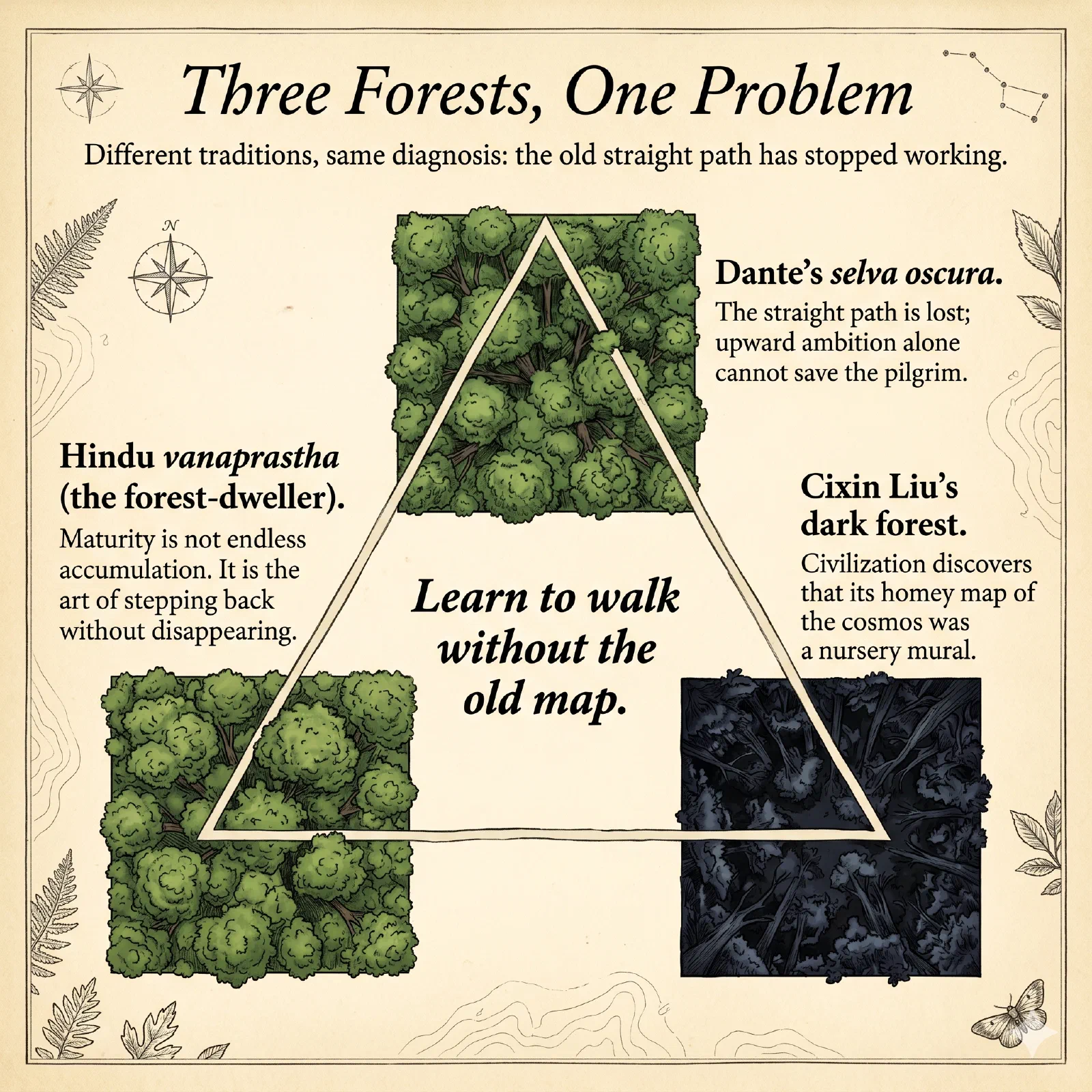
The dark forest has carried three senses in this essay — a psychological condition, a cosmic predicament, and now a cosmology — and the work in each case is the same: don’t retreat, grow. The dark forest is currently our society’s most dominant cosmology.17 Read pessimistically — if your main value is not changing — it is a counsel of despair: the universe is dangerous, the comfortable mediations have failed, hide. But the same cosmology, read as provocation, says something else. The work is not to retreat into a smaller cosmology but to grow into the larger one. Even the aspiration to look beyond what is comfortable and at hand is itself a form of cosmic self-assertion — a refusal of the door-slamming, a small step toward the wider consciousness the dark forest is asking for. Liu wrote at the end of Death’s End: the ultimate fate of all intelligent beings has always been to become as grand as their thoughts.
Coda: A Note for Contraptions Book Club Readers
This essay’s framework fits within the World Machines thesis (which grew out of the Contraptions Book Club). The framework runs on a Dawn / Day / Dusk lifecycle, with three machines coexisting at any given moment. The Modernity Machine (Dawn c. 1200–1600, Day 1600–2000, now Dusk) was the cookie-cutter map at civilizational scale — legibility, convergence, canonicity, the straight path to the Enlightenment future. The Gramsci Gap — the “time of monsters,” the interregnum between the rules and rulers of an old world and a new one — is the selva oscura at civilizational scale, the period when the question persists and the answer does not. The Divergence Machine (Dawn 1600–2000 on the margins of the MM, Day 2000–c. 2400 on the ~400-year Day estimate) is the wider consciousness at civilizational scale — pluralism, coexistence without closure, the trackless territory walked rather than crossed. (A still-Dawning Liveness Machine is the one after that; out of scope here.)
Read this way, the personal midlife of the writer (me, awakening in COVID) and the species-scale midlife at the end of the Modernity Machine (all of us, around now) are the same developmental crisis at different scales of magnification. Liu’s developmental sequence (cradle → toddler → flight) and the world machine sequence (MM Day → Dusk while DM Dawn → Day) are doing similar work. The discipline the Divergence Machine asks of us is the discipline vanaprastha asks for: presence over flight, bearable proximity, work on myth, opening the door a second time.
Cixin Liu, Death’s End, trans. Ken Liu (Tor Books, 2016). The image closes the chapter on humanity’s response to the Doomsday Battle and Battle of Darkness. ↩
Dante’s tercet from Inferno I, opening lines. The English rendering follows Henry Wadsworth Longfellow’s 1867 translation (public domain). The first-person plural — di nostra vita — is doing real work the singular di mia vita would not. ↩
Both passages above are from the Genjōkōan (1233), one of the foundational texts of the Shōbōgenzō. The wording I use is Alan Watts’s adaptation — he renders the firewood/ash and seasonal-stage logic in a freer, more colloquial English than more scholarly translations. Watts treats the passage in lectures and in The Way of Zen (Pantheon, 1957) ↩
If you can think of a better characterization of middle age than Dante’s, I beg you to provide it in the comments. ↩
Carl Jung, “The Stages of Life,” in Modern Man in Search of a Soul (Harcourt, 1933). Jung’s most direct treatment of the second-half-of-life developmental task; the encounter with the unconscious is what the first half of life works to keep at bay ↩
The three beasts of Inferno I are a leopard (lonza), a lion (leone), and a she-wolf (lupa) — traditionally interpreted as lust, pride, and avarice. The point is that the direct, easy ascent to the good is barred; the way around requires descent, and a guide. ↩
Hans Blumenberg, The Legitimacy of the Modern Age (Die Legitimität der Neuzeit, 1966; trans. Robert M. Wallace, MIT Press, 1983). The reoccupation thesis is most fully developed in the long second part on secularization. ↩
Hans Blumenberg, Work on Myth (Arbeit am Mythos, 1979; trans. Robert M. Wallace, MIT Press, 1985). The opening chapter develops the absolutism-of-reality concept and the role of myth as a distance-creation device. ↩
Cixin Liu, Death’s End, trans. Ken Liu (Tor Books, 2016). The full sentence continues in the original: “The ultimate fate of all intelligent beings has always been to become as grand as their thoughts” — the line that closes this essay. ↩
Cixin Liu, Death’s End, trans. Ken Liu (Tor Books, 2016). Cheng Xin’s recognition of her two refusals — the deterrent button and Wade’s lightspeed program. ↩
Cixin Liu, Death’s End, trans. Ken Liu (Tor Books, 2016). The line is Yun Tianming’s, spoken to Cheng Xin in their final scene together. ↩
Cixin Liu, The Three-Body Problem, trans. Ken Liu (Tor Books, 2014). Liu names him only as Listener 1379 — the gentlest voice in the trilogy and the counter to its Hobbesian cosmology. He reappears (via sophon-mediated communication) at the end of The Dark Forest, contesting Luo Ji’s claim that love is uniquely human and offering the line about love as something worth taking risks for even in a cutthroat universe. ↩
Cixin Liu, Death’s End, trans. Ken Liu (Tor Books, 2016), late chapters. Without further spoilers: Cheng Xin and Yifan eventually become Returners, choosing to give the matter of their pocket universe back so the cosmic cycle can re-collapse. The Returners motif is a good contemporary literary image of vanaprastha. ↩
Hans Blumenberg, The Legitimacy of the Modern Age, Part I. Selbstbehauptung is Blumenberg’s name for the founding human posture in the face of the absolutism of reality — neither aggression nor surrender, but the act of standing upright in a world that does not arrange itself for us. ↩
The classical Hindu four-stage system; for the scholarship and its variations across primary texts, see Patrick Olivelle, The Āśrama System: The History and Hermeneutics of a Religious Institution (Oxford, 1993). What’s described here is the canonical form most often cited in comparative work. ↩
Norman Maclean, A River Runs Through It and Other Stories (Univ. of Chicago Press, 1976), the title novella’s penultimate sermon. The book’s wording: “And so it is those we live with and should know who elude us. But we can still love them — we can love completely without complete understanding.” The 1992 Robert Redford film keeps the line nearly intact in the final sermon — clip on YouTube: We Can Love Completely ↩
Liu’s image has spread far beyond the trilogy. Yancey Strickler’s Dark Forest Theory of the Internet (May 2019) argued that the public web has itself become a dark forest: serious discourse retreats into private spaces — group chats, paid newsletters, dinner tables — to avoid being attacked, decontextualized, or weaponized. The Fermi-paradox community uses dark forest as a candidate solution to the puzzle of why we don’t see other civilizations. Geopolitical realists invoke it as the natural state of international relations: every state is a hunter; revealing your strategy is suicide. The recent moral panics around AI add a third register — AI as an alien intelligence we should not have summoned, the door we have already cracked open. (I argued against this register specifically in De-Dramatizing the Digital.) Each domain reads the metaphor a little differently, but the structure is the same: visibility becomes danger; the comfortable cosmology in which the world arranges itself for us has collapsed; the question is what to do once you know. ↩