Looking for Durée
Why time doesn’t flow—we’re the ones that move
“No one knows what time is; certainly no one knows how to define and explain it to the general satisfaction. But we sure know how to measure it.” — David S. Landes, Revolution in Time
I have a very good sense of what time it is. It used to be preternaturally good — scary good — and is now merely very good. I grew up before you were expected to carry the time on your person, so it came in handy. I admit it with some embarrassment: it isn’t cool, and it travels with a collage of other OCD traits. Go too long without checking my internal clock against a real one and I get nervous. Punctuality is the closest thing I have to a reliable civic contribution. For years I filed this under discipline. Lately it has started to look closer to hypervigilance.
May was Revolution in Time month in my book club, so I dove into David Landes and a stack of side quests.1 As the weeks went on, I raised my sights: I would figure out longitude, and I would understand time itself better. One of them worked out. The other didn’t. I bet you can guess which one. I also threw in some meditation practice to see what it might add. That worked — though not in the way I expected.
The Physicist and the Philosopher was the one I read hoping for a definition of time. I didn’t get one. What I got was the shape of the argument. On one side, Bergson — time as duration, continuous, lived from the inside, the thing that makes a self feel like one continuous self, and flowing one way only. On the other, Einstein — time as a fourth dimension, relative to the observer, with no privileged now and no preference for which way you run it. I went into May with my own experience filed firmly under Bergson. I came out leaning toward Einstein. By the end of this essay I would like to have given you a sense of why.
Public and private time
There is a public clock — the one Landes traces the long arc of — and a private clock running in your body. And there is now a third thing, personal but not private: the clock in your phone. It keeps the same time as everyone else’s: your portal into the shared time-world, that astonishingly successful conspiracy of nation-states, international organizations, scientists, satellites, and the cesium atom. We will come back to the phone — it turns out to be less a clock than a force in its own right.
The public clock is a successful boss. It turns local rhythms into official time, trains bodies to meet schedules, and makes a minute in joy and a minute in a checkout line formally identical. Most of all it turns time into a standing reserve — a commodity we treat like money, something that can be saved, spent, optimized, stolen, or wasted.2 I had — lazily, it turned out — assumed the body’s time was the opposite: qualitative, continuous, flowing, a refuge from the outside world.
Exterior and interior time
Landes’s exterior time begins as the continuous flow of natural time — sundials, water clocks, the wheeling of the moon and stars. The arc of his book is the building of timekeepers: monastery, then church and town square, then portable for the ship and the pocket. The detail that sticks with me is that one day in the eighteenth century the made-up time became the real one and the sun was the thing running slow.3 From Landes:
The sundial had always been the time standard of reference and control, except for those special people such as astronomers who knew how to observe the transits of heavenly bodies. Yet the sundial is itself a less-than-fine instrument… hard to read, even under the best conditions, to less than five minutes. But the availability of reliable, accurate timekeepers, working day and night, on cloudy days and clear, led people to order their lives more and more by mean time rather than by the sun. Soon sundials were built with conversion scales… instead of setting by the sun, people corrected the sun.
Interior time, Landes says, followed exterior time’s lead — time discipline, punctuality as a virtue, all of it internalized once the shared clock arrived. Consciousness seems to be, at bottom, consciousness of time: there is no continuous self to speak of except across some stretch of duration. The body has its own sense-access to time, too.
So a 2x2 suggests itself — public against private, exterior against interior:
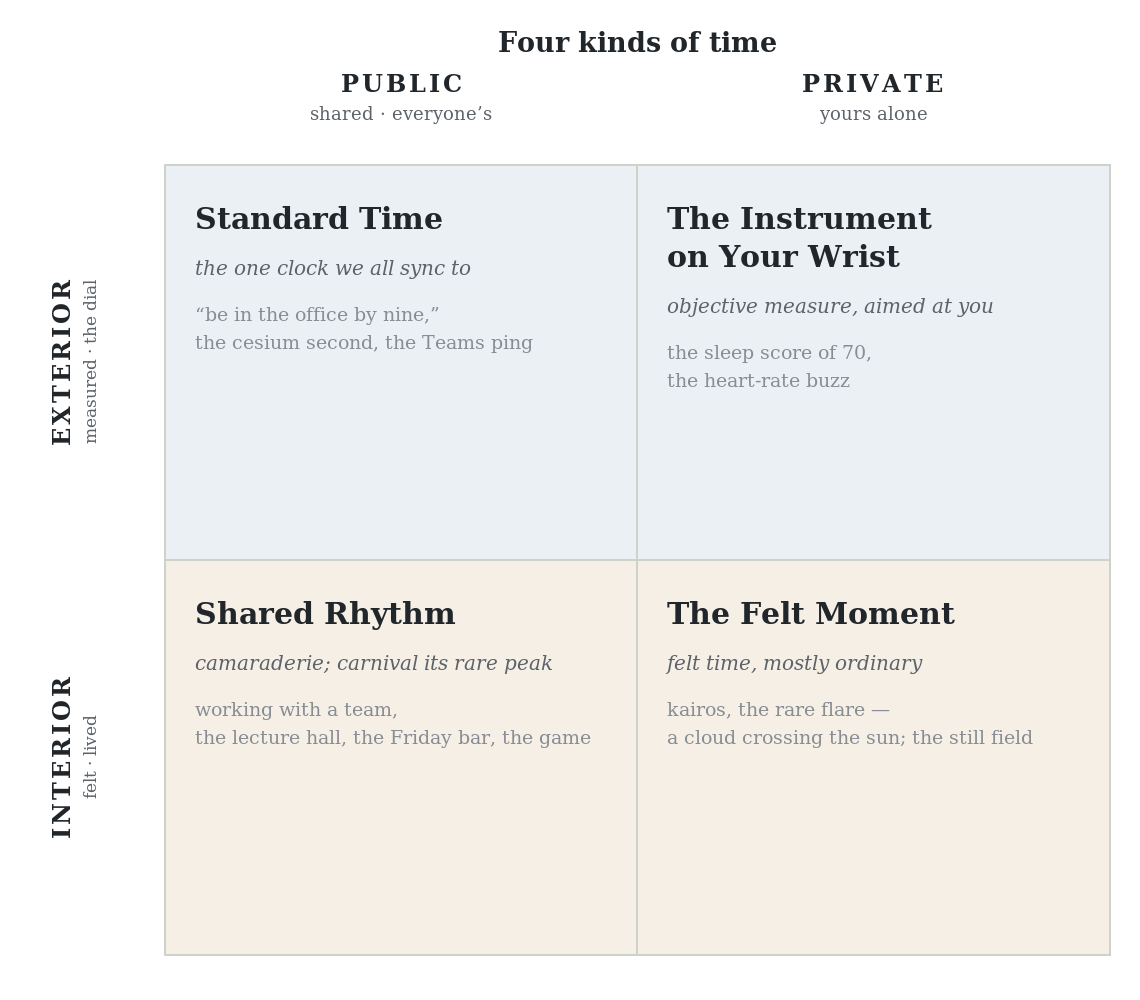
Four kinds of time, then. Standard time, the one clock we all sync to. The instrument on your wrist, the same objective measure aimed at you alone. Shared rhythm, one shared hour felt by a roomful at once. And the felt moment, mostly ordinary lived time, lit now and then by moments with weight. One box, though — the felt moment, bottom right — I’ll have to redraw before this is over.
What counts
So far we have been talking about what the Greeks called chronos: countable time, one moment after another. They had another word, kairos — not time as sequence but time as occasion, the moment that has become the moment. We all know it: the suddenly serious conversation, or the few minutes before leaving when the whole household suddenly has to cooperate. It comes unannounced — attention centers, the body responds, and time seems to slow. Anything can happen.
English half-hides the distinction inside a pun. A thing counts when you can number it — one, two, three minutes. A thing also counts when it matters.4 Chronos is the time you count; kairos is the time that counts. Right now, try to remember something from a long time ago. It is likely kairos.
On the diagram, the bottom row is felt, lived time — and kairos is the rare flare that lights up in it. Memory does not treat all moments equally. A year of routine holds as many hours as any other year, but if nothing in it landed, it comes back as almost nothing. The science says a flat stretch with no change of feeling never gets cut into separate episodes, so memory files the whole year as one short event, or none.5 If very little of it was lived with any resonance, very little will be remembered.
The earliest personal watches knew this. Here is Landes:
“The timepieces of the fifteenth and sixteenth centuries were often memento mori, of skull form or engraved with a motto reminding the user that every moment was precious, for every tick brought him closer to his final reckoning.”
The first person to carry time on the body was carrying a reminder of death, an agent of kairos, not a productivity tool. But, as Landes puts it, time saved for the sacred is just as easily saved for the profane. Time-thrift, once anchored to the final reckoning, slid quietly into the merchant’s ledger. A watch can remind me I will die. It can also remind me I am late for a call.
Chasing Venus
Guillaume Le Gentil makes the gap between chronos and kairos almost cruelly real. He is one of the heroes of Andrea Wulf’s Chasing Venus, the eighteenth century’s great collaborative gamble to measure the distance to the sun by timing the transit of Venus from opposite ends of the earth. He sailed from France in 1760 to observe the transit from Pondicherry; the Seven Years’ War kept him from a usable observation of the first transit, so he stayed in the Indian Ocean eight more years to wait for the next one. In the weeks before the 1769 transit the sky was clear every morning. On the morning itself a cloud covered the sun for almost exactly the duration of the event. He came home eleven years after leaving to find he had been declared legally dead, his wife remarried, his estate divided. He was, by every countable standard, on time. Clock-time could coordinate the expedition. It could not guarantee the occasion — though I expect the kairos of watching that one cloud cross the sun stayed with him for the rest of his life.
Much of life is spent trying to make chronos deliver kairos — trying to make what we do matter. And sometimes kairos transfigures chronos: a twice-in-a-century event opens an occasion of its own, the moment the universe reaches into your private time and folds it into cosmic time (which is why some call kairos God’s time). No wonder the temptation is to trust the body over the clock — the body knows what matters; the clock only counts. Loosen the clock’s grip, the dream goes, and we get back more body-time, more kairos, more durée, more local rhythm. It is a beautiful dream.
Except — then I woke up, and noticed that my body was counting too.
The body keeps the time
Just like Bergson, I assumed that under the public clock ran a private flow, continuous and uncounted, the romantic’s durée. So I went looking for the stream in the one place I was sure I would find it: my own body. What I found was another clock.
There is no single clock in the brain. Split-second timing runs through the cerebellum. The span we actually live in — seconds to minutes, the felt present — gets assembled somewhere stranger: the insula, the fold of cortex that answers the question: how do you feel, right now? The insula is not a clock so much as a confluence. Three streams run in — what you are attending to, whether you are safe or afraid, and the body itself: heartbeat, breath, gut — and what comes out the far side, synthesized from all three, is the thing we call the present moment. Lived time is synthesized, continuously, from the inside.
And the heartbeat is the pacemaker in that synthesis. In one 2025 study, researchers played people emotional film clips, watched the heart through each one, and asked afterward how long each had lasted. They expected the unpleasant clips to feel longest — fear dilates time, everyone knows the cliché. They got the reverse: the clips that slowed the heart most were judged shortest. Slower heart, shorter estimate; the mind read the count off the organ and believed it.6 Perceived duration even swells and shrinks within a single heartbeat — the moment is a slightly different length at the top of a beat than at the bottom. The heartbeat works quite literally like an escapement: a pulse that gates duration, counts it, and makes it usable, the same as a clock.
That knocked the floor out of my tidy opposition — the warm body against the cold, counting clock. But the body counts too. Go looking in the heartbeat for durée and you do not find the stream; you find another escapement. If there is no flow in the body, where, then, is it?
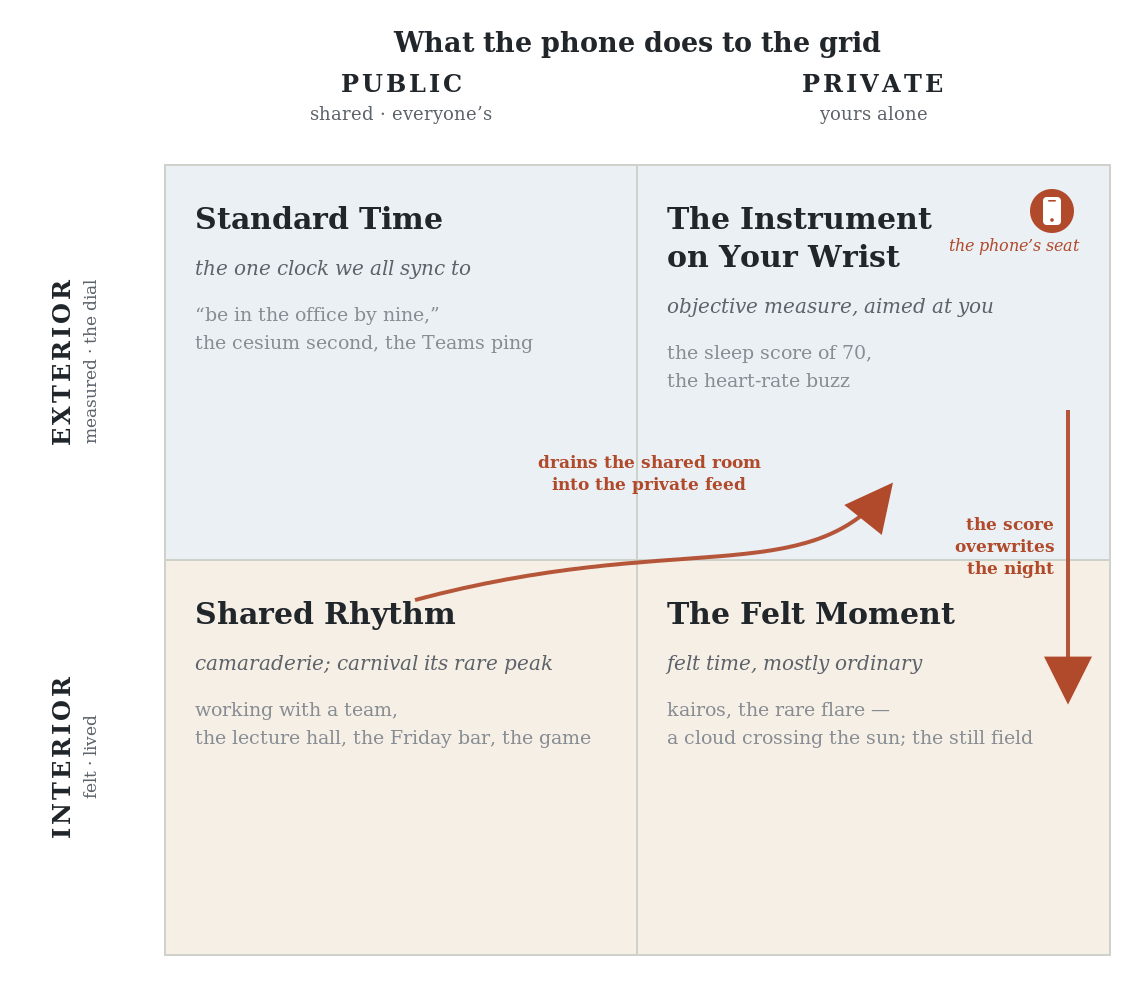
Let’s return to the instrument on the wrist: it no longer just keeps the time — it counts me now, too. It scores my sleep — not describes, scores. My sleep score was 70 this morning. I should have gone to bed earlier. On mornings when I wake rested and the score comes back low, I feel less rested. The number overwrites the night. My hypervigilance loves it — it is the same reflex I opened with, the part of me that can’t rest until the inner reading and the outer one are in sync. On the diagram, this is the device stepping out of its own box — the private instrument, top right — and pressing down into the felt moment.
Chronos crowds out kairos
Being phase-locked to the public clock is useful, but it dulls the body’s other registers. Kairos still takes over when it comes; you cannot miss it. But I leave fewer openings for it, because I have trained myself to override the body’s early signal in favor of the drumbeat — what time is it, what is next, how long do I have, am I late? Landes with the modern wish:
“We, living by the clock, see ignorance of or indifference to time as a release from constraint and a gain in freedom. When we go on holiday, we want to be able to put our watch in the drawer.”
You can be lost in thought at the dinner table, half-present to your family, when a Teams ping enforces standard time and your smartwatch buzzes that your heart rate is elevated. Modern life is the noise of all four quadrants demanding the same time.
So the answer cannot be a simple return to the body; the body is already part of the counting. Nor can it be a simple multiplication of clocks. Multiplying clocks this way is the Bergson mistake again: picking one time among supposedly many. There are not many times. There is one field, and many tempos: the rates at which different things move across it. The phone keeps one tempo, the body another, the subway a third. The 2x2 is the parliament of tempos — four constituencies, no one in charge. A day needs an edge: something that lets one tempo govern the hour while the rest wait.
What happened when we lost place
For a long time, place supplied that edge without our noticing. The café, the gym, the bar each kept its own tempo. “Be in the office by nine” was a single fact, a time and a place at once; to leave the place was to leave the tempo. The office was a shared mood of people working on the same problem.7 Failing at work used to mean letting down people you would see the next morning. There was also the full lecture hall, the bar on a Friday, the basketball game. Even the commute, awful as it could be, was a threshold, and it gave the day an edge. On the diagram, this is the bottom-left box — shared rhythm — the one place public kairos can happen.
Then the weld between time and place was cut. The pandemic left the clock intact and dissolved a great many thresholds, and the gain was real. Place had been a cage for plenty of people, and its loosening did real good. But I don’t need to tell you that you don’t leave work anymore; you log off, which is a poor substitute for a door.
The loss was the ordinary public interior. And the sad part is that going back doesn’t restore it. I like the office; I still go in when I can. But now I’m one of three people there. The room is public and empty — which is just my home office with a worse commute. I am in public with no one to be in public with. I half-like it, and also know it is not what an office is for.
The phone also drains the bottom-left box — shared rhythm, the shared interior — into the top-right, where it sits. This is the change I’m least at peace with. The shared room becomes a private feed; the carnival, and even the ordinary Tuesday, has to be convened now.
None of those places were paradise. But each let certain encounters simply happen, without requiring every person to become their own event planner. Reaching one another has become something each of us has to initiate, where place used to do some of the work.
The Physicist and the Songwriter
I warned you at the start: I set out in May to understand time better, and mostly failed. What I can offer instead are my own field notes, which I think actually prove more useful. During meditation I went looking for durée. If Bergson was right, I assumed it ought to be there — somewhere beneath the noise a living current, the continuity under everything, waiting to be exposed to those who are patient and can quiet themselves.
It’s not there. I looked for a month and found no evidence of it. I know a month seems short, but Bergson’s claim was that duration is immediately given, present in the moment, not something hidden that requires searching. A month of unlabeled attention — no noting, no tagging what arose as arising — is a generous run at a claim built on immediate access. What did happen: things arose and passed away, and that was the whole of it.8 Whenever something like duration did appear — a lingering thought, a sharp memory, planning — it wasn’t the deep truth surfacing; it’s practice going badly. Return to the breath and the current vanishes. I can think this breath came after the last one, but that is only a thought, and thoughts have no special ontological status in Buddhism. Durée is nothing but a thought. It describes experience and then mistakes this description for reality. I agree with Einstein: the time of the philosophers does not exist.
What is left when the lingering thoughts stop is nothing special — not interesting, not mystical. It is a still field. Without meaning to, I had run the Buddha’s experiment: he went looking for the self and found no one home; I went looking for duration and found no flow. No stream, no self. Maybe those are not the same discovery, but they rhyme.9
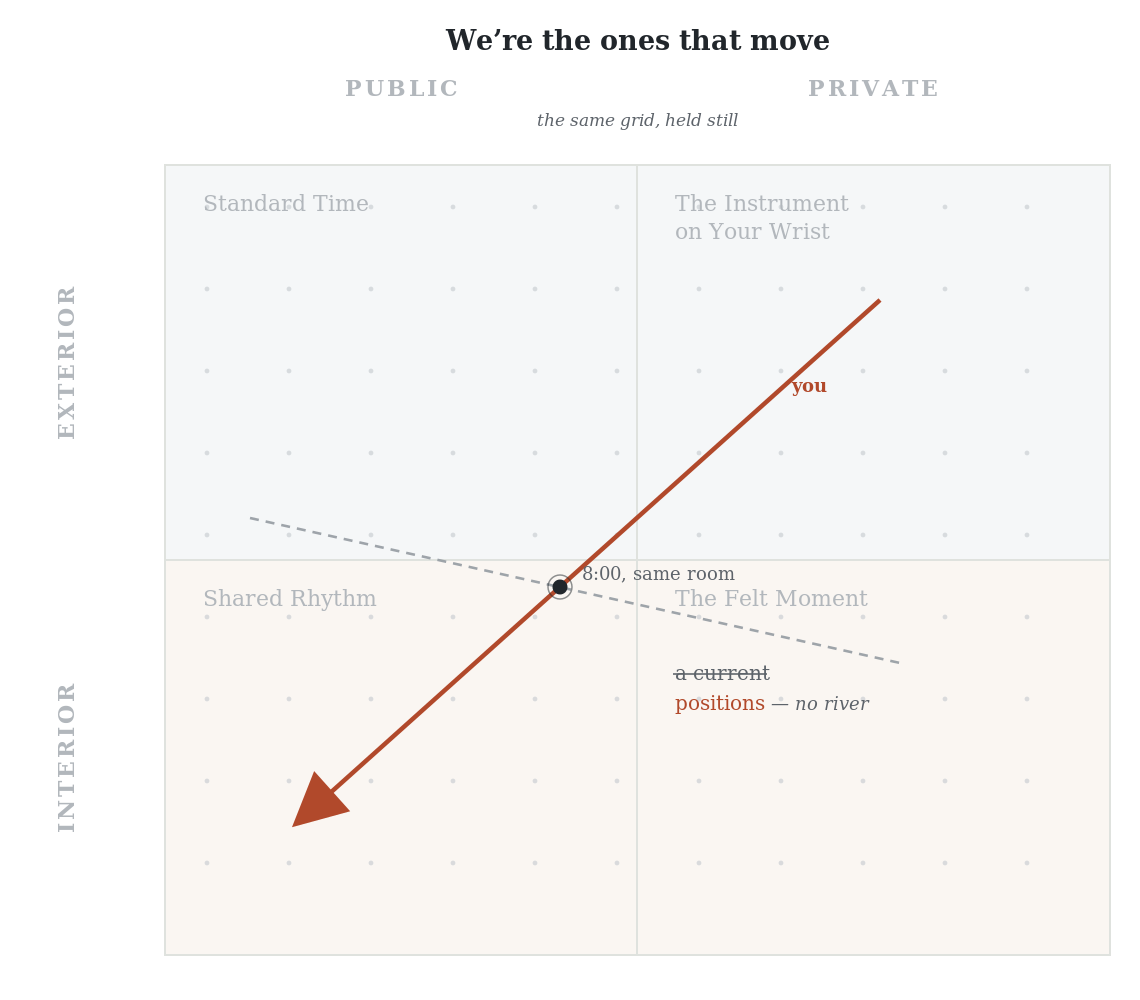
That settles the one box on my diagram I had promised to come back to — the felt moment, bottom right, where I’d filed durée, the romantic current. There is no current. There is sequence, memory, anticipation, causality. There is the mind’s habit of stitching these together and calling the stitch a river. But there is no river.
So where to go? I got a small jolt of kairos from a few lines of Bob Dylan’s, turned up in the unlikeliest place — a newspaper column occasioned by Donald Trump’s eightieth birthday. Dylan, now eighty-five, wrote:
“When you’re young you think that time moves forward. At eighty you know that it doesn’t, it stands still. We’re the ones that move.”
Dylan’s genius is to take the verb away from time and give it back to us. Nothing in the philosophy I read fit as snugly. Dylan got closer than the people who were trying. Dōgen got there too, seven centuries earlier and with more metaphysical nerve: spring does not turn into summer; first there is spring, complete, then summer, complete.10 That is the force of uji: each thing is its own being-time, not a passage through a container of time. Spring is not a station on a line called time. It is a complete mode of existence, just as summer is. The seasons do not flow into one another because there is no river underneath them. There is order, there is arising and passing, there is karmic continuity — but no hidden current.
That leaves the obvious question: if nothing flows, what accounts for change? My answer takes a cue from Dōgen. What links one instant to the next is cause and effect, not temporal passage. The world is complete at every instant; past and future are real as order, not as a current. This isn’t a hidden durée. A causal relation between two complete moments doesn’t require anything to pass between them, any more than Einstein’s light cones do — earlier events constrain later ones through structure, not through flow. Karma is that same structure, applied to body, speech, and mind instead of matter and light. What moves across the still field, then, is momentum, not substance: some of it deliberate, the result of choice, some of it inherited, the carried force of prior acts still working themselves out.11
That is why I no longer find Bergson convincing. Durée now looks to me like a phenomenology of a certain kind of subject: memory-saturated, forward-leaning, affectively continuous, always blending what has been with what is about to be. That experience is real enough. Bergson saw that lived experience is falsified when chopped into countable units. What he did not earn was the leap from that fact to an ontology of time. Duration is not what time is — it is what a subject can feel when it mistakes its own motion for reality.
Out of curiosity I asked an AI how it experiences time. Its answer was clarifying. It said it has sequence but not duration: before and after, but no waiting; order, but no felt stretch between events. A pure creature of chronos, all order and no flow — and it sounded less like me at my most harried than like the still field Dylan was pointing at. Here is the rest of what Dylan said:
“The best thing about being eighty is that you outlive the clocks that have been chasing you. It’s freedom from that lie that anything was ever under control.”
Dylan stumbled onto something two of the most famous minds of the last century had already fought to a standstill. In 1922, at the Société française de philosophie, Einstein and Bergson debated exactly this. Relativity had already made simultaneity relative — no single instant counts as now for the whole universe, only now for this observer, moving at this speed. Bergson argued that clock time and lived time were never competing in the first place — physics measured a spatialized shadow of duration and left the durée we actually live untouched. Einstein disagreed: there is physical time and psychological time, and nothing else. Bergson spent the rest of his life losing that argument. Nothing in the equations needs a flow, only an order.
The stream was never there. Neither, it turns out, was much else I’d gone looking for. No hidden current, no universal now, no one keeping the time. Einstein, Dōgen, and the still-field intuition meet at one negative insight: time is not a common river carrying beings forward. But they also agree on what remains: a web of cause and effect. Relativity applies it to the physical universe: strip away simultaneity and what's left invariant is causal structure. Karma applies it to life. Physics explains the cosmos. Karma explains why my anger from last Tuesday still affects me today. Maybe that means I can let go of the hypervigilance, or at least stop trying to sync to a current that isn’t there. Dylan already found that freedom: outliving the need for the clock. There is no common now to sync up with; there is only common counted time.
There is a loneliness inherent in the thought of no shared now. The temptation is to let these grand pronouncements on time trick you into not putting the effort into creating shared moments (even if they aren’t precisely the same). But this is lazy. Lives can share events: particular points where the worldlines actually cross, 8:00 in the same room, a fact everyone can agree on. The freedom of this vision puts the responsibility for intersections on you. It is a still field we have to move around in. The intersections don’t arrange themselves — we make them happen.
Three side quests: Andrea Wulf’s Chasing Venus, Dava Sobel’s Longitude, and Jimena Canales’s The Physicist and the Philosopher. ↩
The time-as-money metaphor — time spent, saved, wasted, invested — is one of Lakoff and Johnson’s standing examples in Metaphors We Live By. ↩
We have since pegged the second back to nature — to the cesium atom — but I still call clock time man-made: we could have cut the hour into something other than sixty minutes and simply didn’t. ↩
The same metaphorical quirk Lakoff and Johnson point at: we reach for count in both senses without noticing the seam. ↩
Emotionally arousing and novel moments are consolidated more strongly — the “emotional enhancement of memory” — and large shifts in feeling appear to segment experience into discrete episodes; a flat stretch with no shifts resists being cut into rememberable units at all. See “Emotion enhances remembrance of neutral events past” (PNAS, 2006) and “Dynamic emotional states shape the episodic structure of memory” (Nature Communications, 2023). ↩
The reversal is from Volodina, Rusinova, Terenteva & Kosonogov, “Interoceptive signals and emotional states shape temporal perception through heart rate modulation”, Frontiers in Psychology 16:1610347 (2025): subjects watched emotional film clips under continuous heart-rate monitoring, and the clips that lowered the heart rate were underestimated in duration, with heart rate partially mediating the effect — the opposite of what the older “fear dilates time” literature predicted. The insula as the hub where interoception and felt duration meet is Bud Craig’s “How do you feel — now?” (2009) and the meta-analysis of Teghil et al. (2019); the finding that perceived duration shifts within a single cardiac cycle is recent electrophysiology. The heart is one input among several, not the whole story. ↩
I am borrowing the distinction from Sachin’s The Two Memories: archival time is private, written, asynchronous; carnival time is public, embodied, synchronous. ↩
Those expert in meditation are laughing at me right now. ↩
One caveat: my case against the stream is wrapped up in there being no self to do the flowing. ↩
I talked myself into Dōgen’s uji in La Selva Oscura, and still believe it; this is me noticing that belief and felt experience had, until Dylan, come apart. The closest I can get to the feeling is a limit in calculus: you accept the value is exactly zero even while you keep picturing a very small number. ↩
I see karma as the momentum of the universe — in any given moment, the vectors of your body, speech, and mind. ↩