The Art of Nature
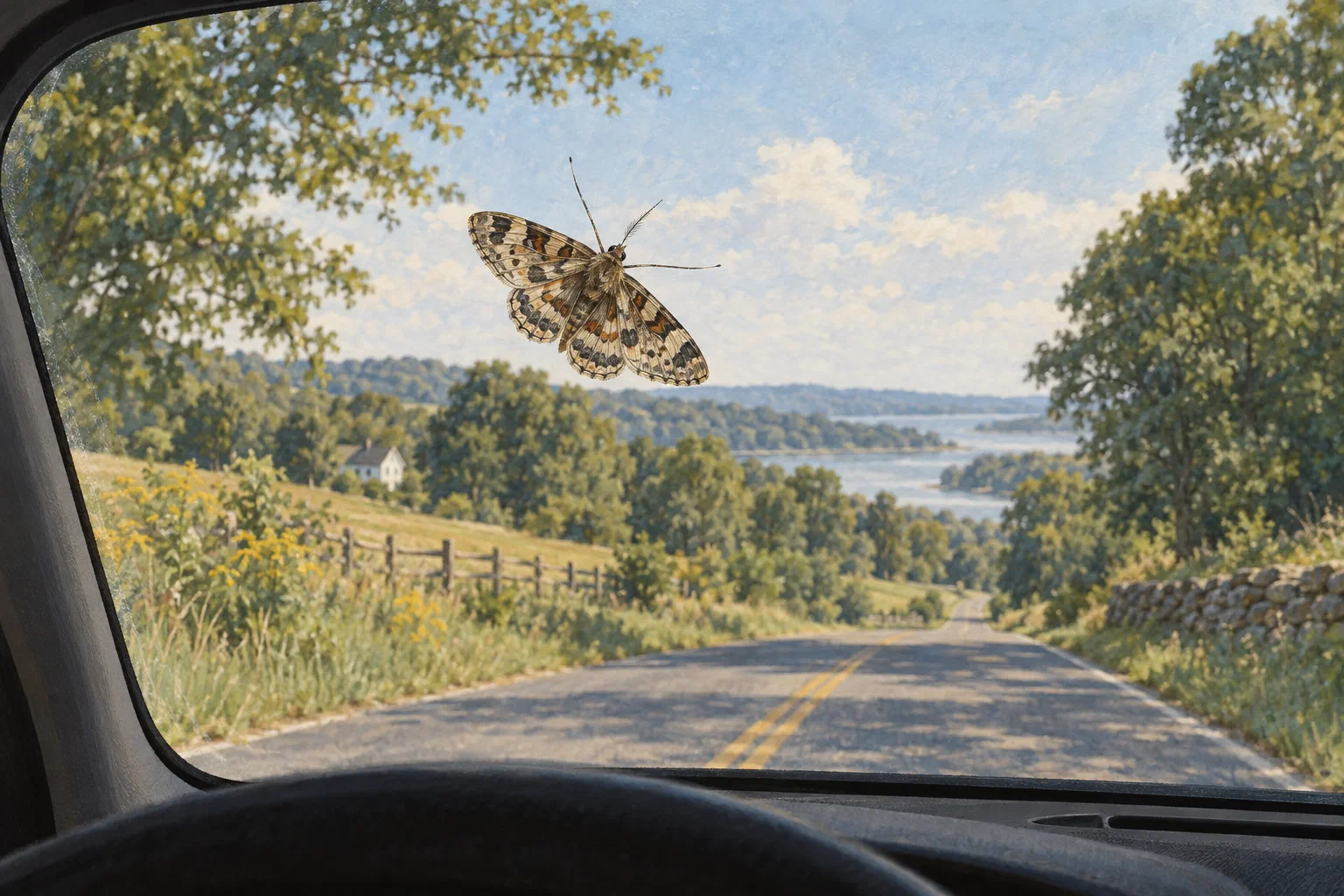
There used to be more bugs on the windshield
There used to be more bugs on the windshield.
I don’t mean this as metaphor. When I was a kid, a summer drive from Annapolis to Ocean City left the front of the car stippled with insect remains. Now that doesn’t happen. Somewhere in the last thirty years, the bugs thinned out.
What a pity! Everything about nature is always bad news it seems. Or perhaps this is good news? Maybe the bugs were evolving?
Cars have killed insects for about a century, and insects can breed fast—houseflies can go from egg to adult in little more than a week. The selection pressure is obvious. The ones that flew into traffic died; the ones that stayed low or swerved passed on whatever had saved them. With each generation the windshield got cleaner. Natural selection in real time. Bob’s your uncle!
I found this deeply satisfying. It was a good story: nature absorbing another human intrusion and becoming cleverer in response.
It is also wrong in every particular.
In 2016, the entomologist John Acorn examined what he called “the windshield anecdote” in American Entomologist and found it wanting. Fair enough: my memory is not the same as a census.
But people also tried counting. In Kent, a citizen-science survey estimated seventy-two percent fewer insects on vehicle number plates in 2021 than in 2004, after accounting for several differences between journeys.1 So, bad news. My evolutionary story had left out pesticides. And habitat loss and light pollution and climate change. In many places, there are simply far fewer insects. Funnily enough, the 2019 Kent survey found higher splat rates on newer cars than older ones. Better streamlining was not an obvious escape route either.
It’s annoying when you can’t let yourself off the hook.
Holding nature still
This essay asks how we might think about nature so that we harm it less while keeping what progress has given us. The difficulty is at least four hundred years old. Experimental science has done many great things. It has also enabled us to treat nature as material for human use, creating a steady stream of bad news with no clear way as individuals to act on it.
To understand how this came about, we have to start with the need for dependable knowledge. What we learn today has to help us anticipate what nature will do tomorrow. Then, once you establish what a thing is, you can consider how it might change over time. You need the curve before you can take the derivative. Before you can see change, you have to hold something still. Linguists have names for these two views: synchronic, a thing as it stands at one moment, and diachronic, a thing as it moves through time.
David Wootton’s The Invention of Science describes an older division between science, a system of theoretical knowledge, and art, a practical capacity to act, make, and otherwise effect change. For Aristotelians, he writes, the study of nature concerned “understanding the world, not changing it, so there was no art (or technology) associated with the science of nature.”
Which brings us to alchemy, and to what nature looked like before it had an art. In the 16th century, more people thought lead could be turned into gold than thought that animals had changed at all since God made them and Adam named them in the Garden of Eden. Lead belonged to an art. Alchemists believed it could be worked upon and transmuted through human skill. Species of animals and plants in the natural world, on the other hand, belonged to science. People observed and classified them but did not think of them as things with histories of their own. Lead was material for practice; species were objects of contemplation.
Somewhere along the way, the word science took on an experimental connotation. An experiment arranges conditions, provokes a response, and makes the response reproducible. As Wootton describes Bacon’s wager, to understand a natural process was to acquire “the capacity to control and reproduce nature’s effects.” Technology then carries that repeatable effect outside the laboratory: to power a car, illuminate a road, protect a crop. Together, experimental science and technology give nature an art.
This was an extraordinary achievement. Science kept fixity and moved it. Stability now lived in laws, measurements, and repeatable procedures. Once the procedure held still, the object could move. Stars could be born and die. Species could acquire histories.
Even in 1861, two years after Darwin’s Origin of Species, Pierre Flourens, permanent secretary of the French Academy of Sciences, declared that “no species has ever changed.” He considered their fixity a demonstrated scientific fact. He mistook persistence for permanence.
An art of nature also made nature available as a means. What we could isolate and reproduce, we could begin to enlist in projects of our own. Studying a thing did not make it an instrument. The art did that. It connected knowing a thing to putting it to work.
This objectification of nature had fabulous results for advancing science. It also raises a question about what makes us good at this art. Is it only getting the result we want, or can the practice teach us to judge what is worth wanting?
Animals and plants became species with their own histories, and through evolution, their own futures. This introduces a second way to read the phrase “the art of nature.” The new science gave us an art applied to nature—the capacity to intervene and manipulate. But as species acquired histories, biologists began to glimpse an art that nature practices itself. The question then became: how did this change occur—and did these species shape their own histories? That is the question of my July book club side quest, The Power of Life.
The power of life
The first person to answer yes was Jean-Baptiste Lamarck, and Jessica Riskin’s The Power of Life is the story of Lamarck working that answer out. Lamarck survives mostly as a joke—the giraffe that stretches for leaves and passes the longer neck to its children—but Riskin argues the giraffe was a caricature drawn by his opponents. Her Lamarck helped establish biology as a science and was the first great theorist of living agency.
Living things, in his account, act. They have needs, form habits, alter their surroundings, and in doing so participate in shaping themselves and the conditions their descendants inherit. The organism acts of itself, and its actions help set the course of its life and its species. For this work, Lamarck earned scorn. He deserved a place in the chain that connects a changeless nature on one end to our current picture of evolution and selection on the other.
Dan Dennett, author of Darwin’s Dangerous Idea—the August book club selection—presents evolution as an algorithmic process, creating design without a designer in a huge but far from infinite space of possibility. His discussion of the Baldwin effect builds a bridge here: learning during an organism’s lifetime can alter selection pressures, favoring inherited capacities that support successful behavior. The acquired behavior itself isn’t genetically inherited, but the organism’s activities still shape evolutionary outcomes without relying on the “heresy” (Dennett’s word, not mine) of passing on acquired traits. Dennett and Riskin still disagree. But the Baldwin effect lets us talk about activity and mechanism without choosing between them.
Dennett, the least sentimental and most pugilistic writer we’ve read in the book club, provided something I found truly touching at the end of his book. Evolution explores Design Space, producing forms that embody histories of adaptation. He calls our biological inheritance “billions of years of irreplaceable design work.” In the Library of Mendel, genomes exist as abstract possibilities; extinction removes an actualized lineage from the living world, not a possibility from the library. Reading this, I felt the loss. The design Dennett mourns belongs to the design space we share. When a creature goes extinct, a part of our shared inheritance is gone, leaving us in a diminished world.
Riskin brings my attention back from design space to the actual creatures living in it. What do they need? What do they do to keep going? Asking what an organism wants does not require imagining a small mind inside it. We can start with its feeding, its habits, the conditions under which it flourishes. We don’t need to return to an old-fashioned animistic cosmology to take those questions seriously.
But that attention can serve more than one end. Riskin describes Lamarck’s student Victor Audouin writing in 1842 about the “tastes,” “habits,” and cunning “tricks” of vine moths. His book was about how to combat them. The same knowledge that makes a creature interesting can make it easier to kill. Appreciation supplies no automatic verdict about the vineyard. It does give us more to consider than the damage to the grapes.
Here “an art of nature” acquires a third meaning: the judgment we develop through practice. Learning how to intervene can reveal beauty and complexity we would otherwise miss.
This brings us back to holding something still. Earlier, we needed a synchronic baseline to recognize diachronic change. Here, the same pause serves judgment: we suspend our immediate purpose long enough to consider more of the thing before us. When we hold it still, we can contemplate what a thing is as a whole. Kant argued that we have to judge an organism as a whole whose parts are reciprocally means and ends, helping to produce and sustain one another.
So what is the problem? Humans claimed a monopoly on ends. The mechanical picture of nature offered explanations that did not require living things to have purposes of their own. But explaining life without reference to its purposes is one thing; treating it as available only for ours is another. Progress could then become the measure of what nature was for: each thing valued by what it contributed to the world we wanted to make.
Kant’s moral philosophy makes a different demand: treat humanity always as an end, never merely as a means. He was speaking of rational beings, not insects or trees. But this is the moral question I want to apply to our dealings with nature: does finding a use for something exhaust what we are willing to value in it?
Progress and its winds of constant change now make everything seem like a potential means to large, systemic ends. A faster road or a more productive field belongs to a larger system whose demands are complex, but whose outputs are useful. We don’t need to allow the bugs to stop progress, nor must we retreat into a rigid environmentalist versus capitalist dyad—a tired dichotomy that needs to be put to bed. But the speed and complexity of our current world frustrate our ability to make judgments. So much exists on dozens or hundreds of levels—we may focus on the goodness of the overall goal, or dive too deep on eulogizing a particular fly. If progress has settled in advance which consequences count, there is very little left for judgment to do.
I got three mosquito bites today and contemplate their destruction every time I scratch. I am open to arguments for leaving them out of the circle of care, and don’t have a knee-jerk aversion to disturbing nature. But being a nuisance to me is not the whole of what a mosquito is.
Back to the bugs on the windshield
The windshield is a product of the first art of nature. Engineers took glass, speed, and aerodynamics and put them to work. My original hypothesis was a story about bug empowerment: the bugs were clever, evolution was beautiful, and the clean windshield testified to nature’s own ingenuity. It was morally tidy. Nobody had done anything wrong, and having admired natural selection, I could get on with the drive.
I never held the insects still long enough to ask what they needed or what had changed in their world—cars, pesticides, artificial light, industrial agriculture, concrete—and my story about their adaptability let all of that disappear into the background. The road had already decided what an insect was for.
Decline is not extinction. But fewer insects means fewer lives participating in the world around us. It feeds the unease that the systems we live inside diminish the world in ways we don’t count, and that they are out of control. This is the bad news we started with. I won’t sacrifice progress, but progress makes sacrifices of its own.
So what does an art of nature offer someone who wants to harm less without giving up their car? Knowing the insects better won’t settle whether to widen the road, but it’s worth pausing to consider what they want from the world and the web of means and ends we share.
It’s been a hot, muggy summer in Maryland, and while writing this I have been very attuned to bugs. I have a non-scientific prediction: the bugs are going to make a comeback. There may be some wishful thinking in this. There are still too few on my windshield, but when I sat in a park I was immediately surrounded by a cloud of darting flies and gnats. They were overwhelming but (almost) never actually landed on me—it was a living tableau of what an experienced meditator might call the miasma of thoughts and sensations. I sat until I stopped being annoyed by them and accepted this was their park, too. My own momentary art of nature.
Coda for the book club
July’s Riskin and August’s Dennett offer different accounts of how living forms come into being, but neither account by itself tells us what to call progress. Dennett’s sense of evolutionary loss makes that distinction especially vivid: understanding how a creature came about does not make its disappearance easier to accept.
This is where we would benefit by returning to our old friends the Modernity and Divergence Machines. The telos of the Modernity Machine, Fiat Progress, judges new experience by long-established standards. The Divergence Machine lets new experience transform the standards themselves. Knowledge grows in two directions. We become capable of doing more, and we recognize more in what we encounter.
Faster travel is a real achievement of the Modernity Machine. Yet learning about the active, self-organizing lives that a road can divide changes what we consider a well-made road. It forces us to ask a different question entirely: how do we build the transit networks we need while making ecological health part of what counts as good design?
The possibility I want to explore in the Divergence Machine is that we can revise our ends as well as our means. Ecological care is not guaranteed. But an expanding understanding of nature can give us reasons to reconsider what counts as improvement.
Books and further reading
Jessica Riskin, The Power of Life
Daniel Dennett, Darwin’s Dangerous Idea
David Wootton, The Invention of Science
Venkatesh Rao, “The Divergence Machine II”
At six trapping locations in German nature reserves, researchers collected 16,966 hoverflies in 1989 and 2,638 in 2014, despite longer trapping time in the later year. ↩